A data-driven deep dive to understand whether it is worth using virtual tours for property listings instead of property photos.
Selling a house takes time. You already know that.
It normally takes somewhere between 10 and 25 showings before someone makes a serious offer.
– PropertiesCT
And that’s understandable. Buyers look into factors such as the neighborhood, price, and different features. If something is off, they move on. Fair enough.
But can you remember the last time you faced a scenario like this?
A buyer inquired about a listing. You could tell he was very excited, and after the conversation, he decided to book a property visit. But on the visit, within 30 seconds of walking in, you could tell he was no longer as excited.
When this happens, you know it will probably end in a rejection.
However, when people say no, they rarely complain about the looks or the quality of the house. In most cases, they will say something like “This isn’t what I expected/pictured” or “This isn’t what the website showed.“
A pricing objection you can work with, or, if it’s a repair concern, you can solve it. But “it’s not what I pictured” is an emotional factor.
They imagined the house after looking at the photos on the listing page, and now it did not match. So they aren’t frustrated with the details. They are simply thrown off by the mismatch in expectations, emotionally. You cannot discount your way out of that feeling.
We want to understand why this keeps happening, so we did some digging.
If you look for professional advice on the matter, many will tell you to use video tours. Others will recommend using virtual tours. But let’s put those commercial recommendations on the side. (Most of them, you will find, are somehow connected to virtual tour software or a VR agency.)
We dug into what actual buyers and real people say in public about their experience with realtors and property listings. In the process, we went through forums, review sites, and a few independent studies.
During this investigation, we specifically looked for answers to:
- Do property photos give buyers enough details to form an accurate expectation?
- What’s actually causing this gap between what buyers expect and what they find in person?
- Do virtual tours close that gap, or is that just a vendor’s pitch?
- Is it really worth investing in virtual tours based on real data?
Let’s look at what the evidence and data actually say, and we’re sure you will find it very interesting.
People Build Up Expectations That May Not Match What’s Real
As mentioned above, most buyers, when browsing listings online, tend to paint a mental picture in their heads with assumptions built from the listing photos and description.
They imagine the space, the layout, the room sizes, wall color, how the kitchen connects to the living room, etc. Some even try to picture how it will look with their beds and furniture placed there.
Every prospect will have a different perspective, and more often than not, it’s not exactly what it is in real life.
If you recall, most questions from prospects are about the neighborhood, materials, available public facilities, such as transportation, schools, etc., around the house, not about the layouts or the room distributions.
Most buyers assume they’ve got the layout and outlook of the house figured out and would rather want to know everything else not in the photos.
Hence, after the visit, the result is that you lose a valuable viewing slot, the buyer wastes their time, and their confidence in your listing takes a hit.
As an independent realtor, this is a serious problem. You have limited time, and you want to make the most out of every lead. So it’s clearly a problem you don’t want to ignore.
Even Worse, People No Longer Trust Photos As Much In 2026
Mismatched expectations are one problem. Adding to it is another problem you can’t avoid:
- Buyers no longer trust photos that much for real estate.
If you go into public forums, you will find several people complaining about how they feel deceived by digitally altered photos and pictures taken with wide-angle lenses that make rooms look larger.
Now, we understand that when you use photos, your intentions are completely pure. You want to give buyers a glimpse of how amazing the property is.
It’s rare for realtors to be dishonest because you want to build up a long-term pipeline where you not only close a single deal, but you want them to refer more buyers to you or maybe buy more listings from you in the future.
However, you’d be surprised how some dishonest realtors cause this, and you have to deal with it even if you were completely honest.
Buyers have a different type of mindset and no longer see photos as a trusted way to judge a property.
This Isn’t Entirely Your Fault. It’s Still Your Problem to Solve
What the evidence shows is that buyers arrive pre-loaded with suspicion about listing photos, whether or not you did anything wrong.
We found a thread on TractorBynet, a general forum, where a couple could not tell from a listing photo whether they were looking at the front or the back of a house, because it sat so oddly close to the road. That one post pulled in a wave of people with lots of complaints.
One user, JasperFrank, compared house listings to dating profiles. His point was that agents do not lie outright, but they quietly leave out a lot of details intentionally. He called it “willful ignorance.”
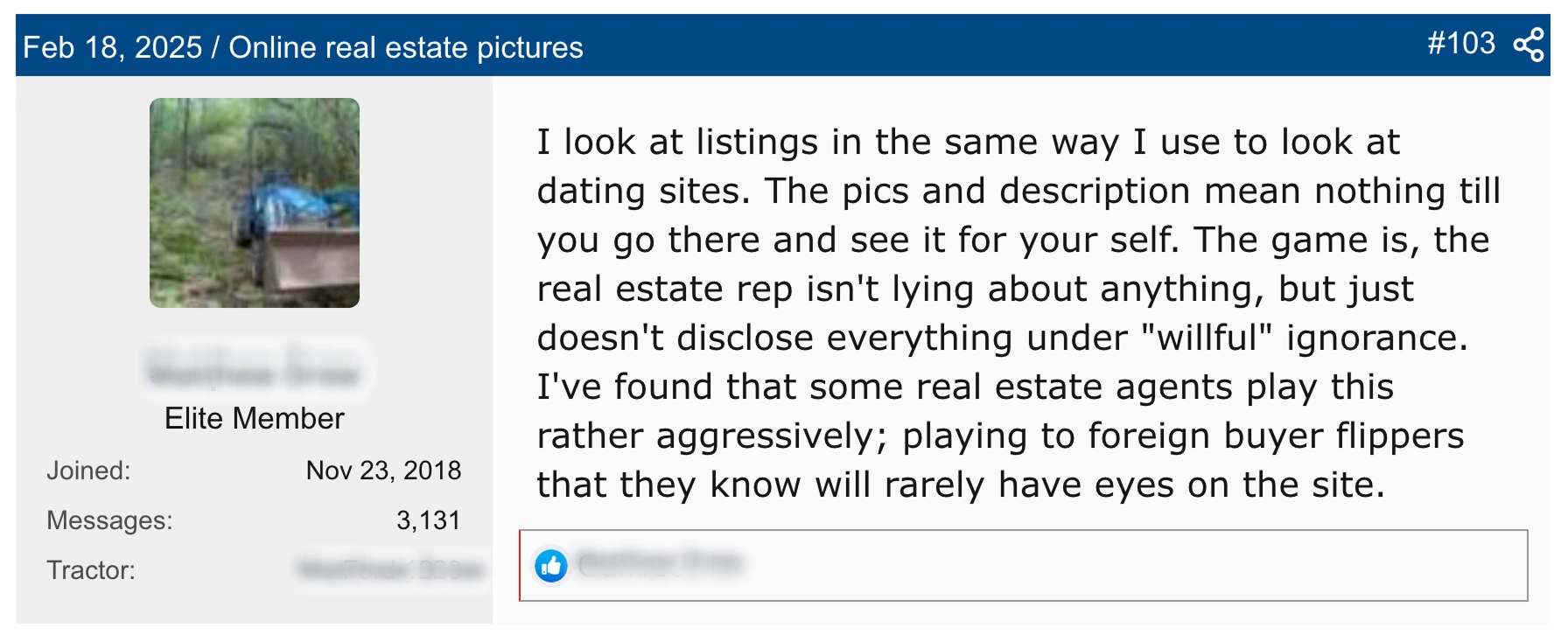
So, from a buyer’s perspective, they assume that listing photos do not give the full picture; You can only get that after a visit.
We found another interesting case in BiggerPockets, one of the largest real estate investing communities.
Here, a buyer shared the frustration of working with an agent who was not transparent about what was included in the contract. They didn’t complain about the photos there, but the lack of transparency broke their trust.
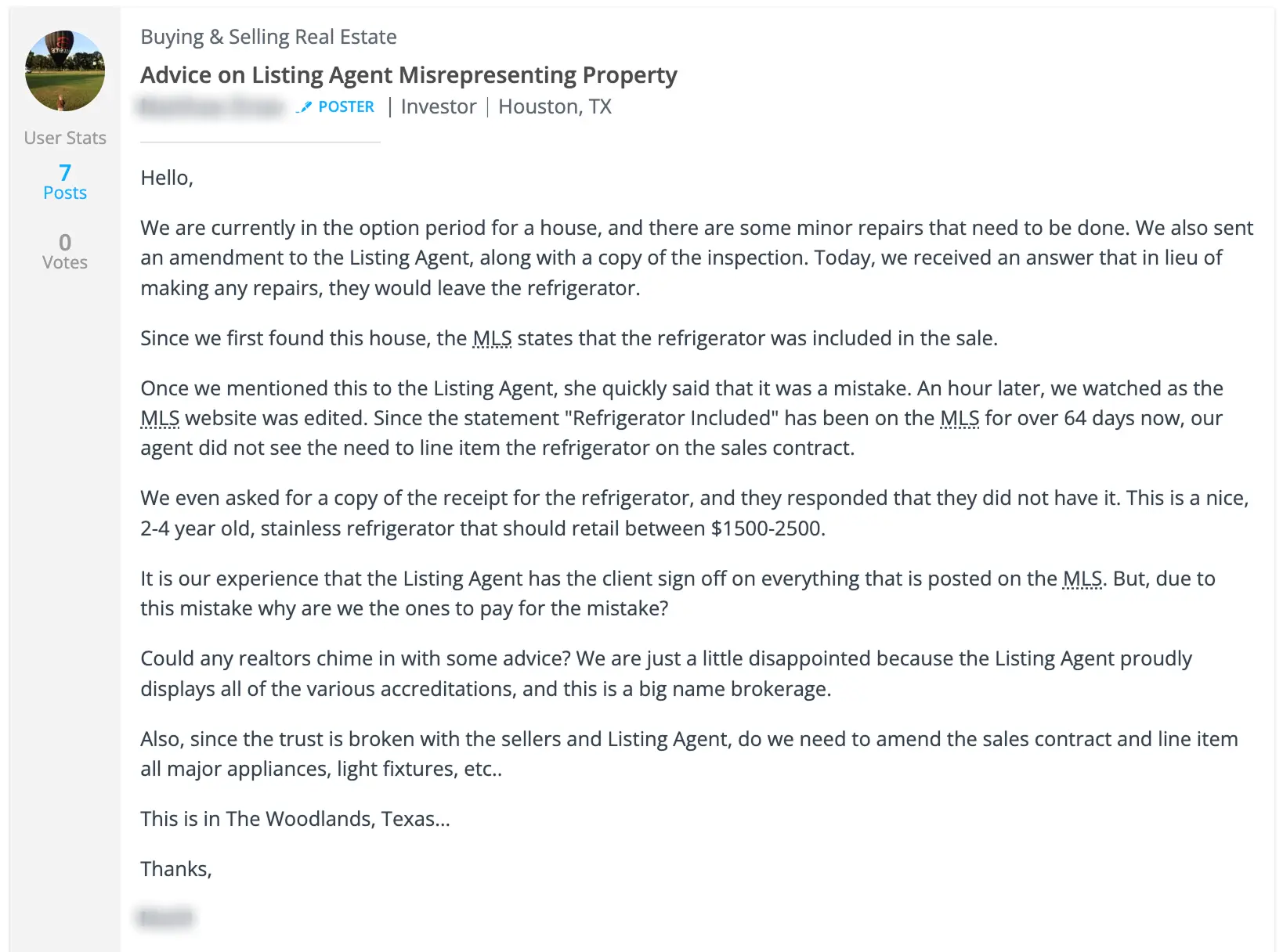
As you can see, the buyer not only felt disappointed, but they also outright lost trust in the listings from this realtor. But this doesn’t end there. Moving forward, they will have a higher level of skepticism with every other agent they deal with.
Now, we know this is not the same with all real estate agents. There are a few outright bad apples who ruined it for everyone else by using image manipulation.
Adding to that, a widely shared Reddit thread, covered by Benzinga late last year, described a buyer who could tell from the photos alone whether a listing was honest or whether they were about to drive forty minutes to see a “spacious” bedroom that turned out to be nine feet by nine. Wide-angle lenses, as he put it, can make a closet look like a suite.
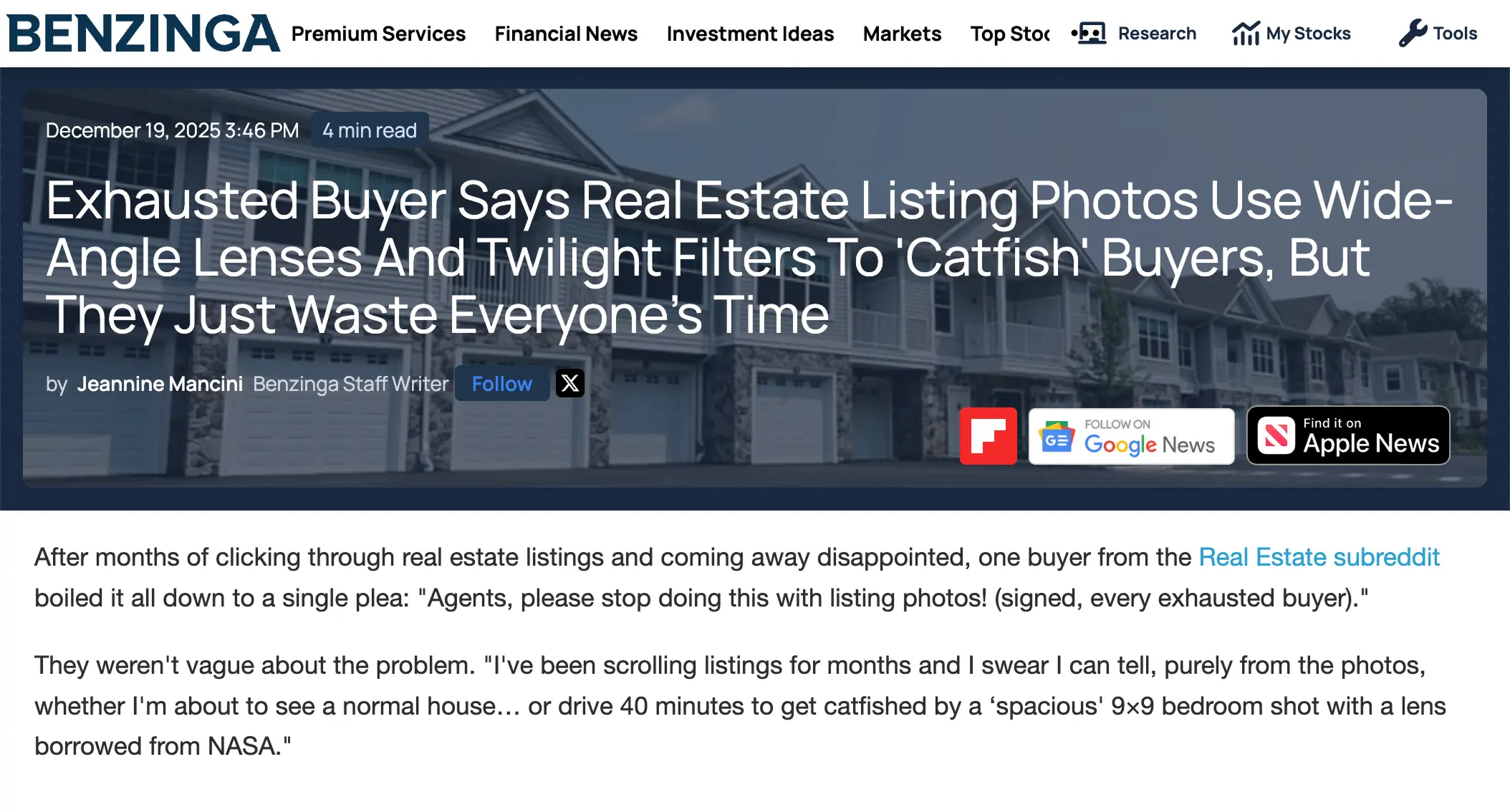
The buyer in question got tired of visiting properties that didn’t match the photos, and similarly, there are many others facing the same issue.
As per Florida Realtors, a trade publication, the issue is serious enough that some states now require disclosure when photos in the listings are digitally edited. They reported that people were also being tricked by fake photos, digitally edited by dishonest realtors.
In their article, a genuinely professional realtor, Ryann Brier, described meeting clients who fell for a dishonest realtor’s listing, in what looked like a lakefront home, complete with a glowing sunset over the water. In person, the house wasn’t even beside the lake. It was across the road, and the lake view was half-blocked by a neighbor’s house.
In her words, it was “definitely not what they pictured.” The clients backed out immediately.
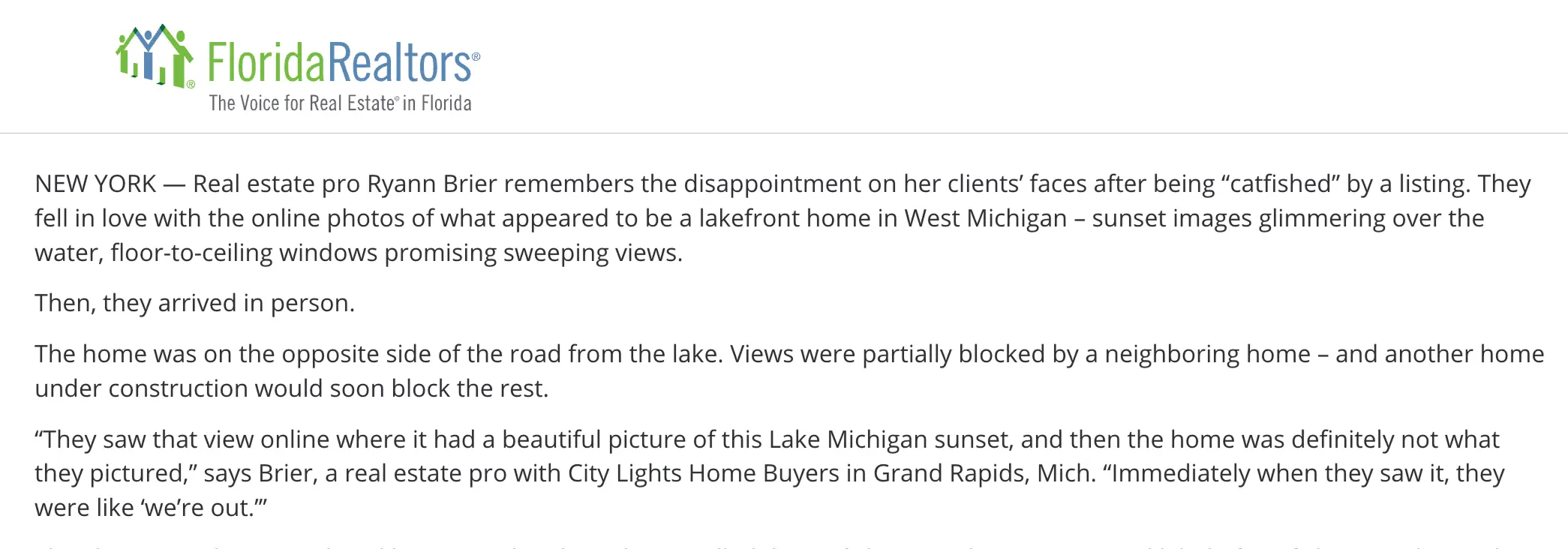
So you can see, you or credible realtors like Ryann Brier aren’t being dishonest. But some people who were dishonest made buyers skeptical about your services as well. And with AI image generation now getting more powerful, how much you can really trust photos these days is questionable.
We also found a similar pattern in reviews on Trustpilot. In fact, we actually found that on review sites, real estate agencies frequently get one- and two-star reviews citing misrepresentation.
One UK agency got hit with a bad review on Trustpilot, where the buyer described that the listings had photos that looked digitally enhanced. And once the buyer saw the property in person, they were deeply disappointed, so much so that they stated that they would never work with this agency again.
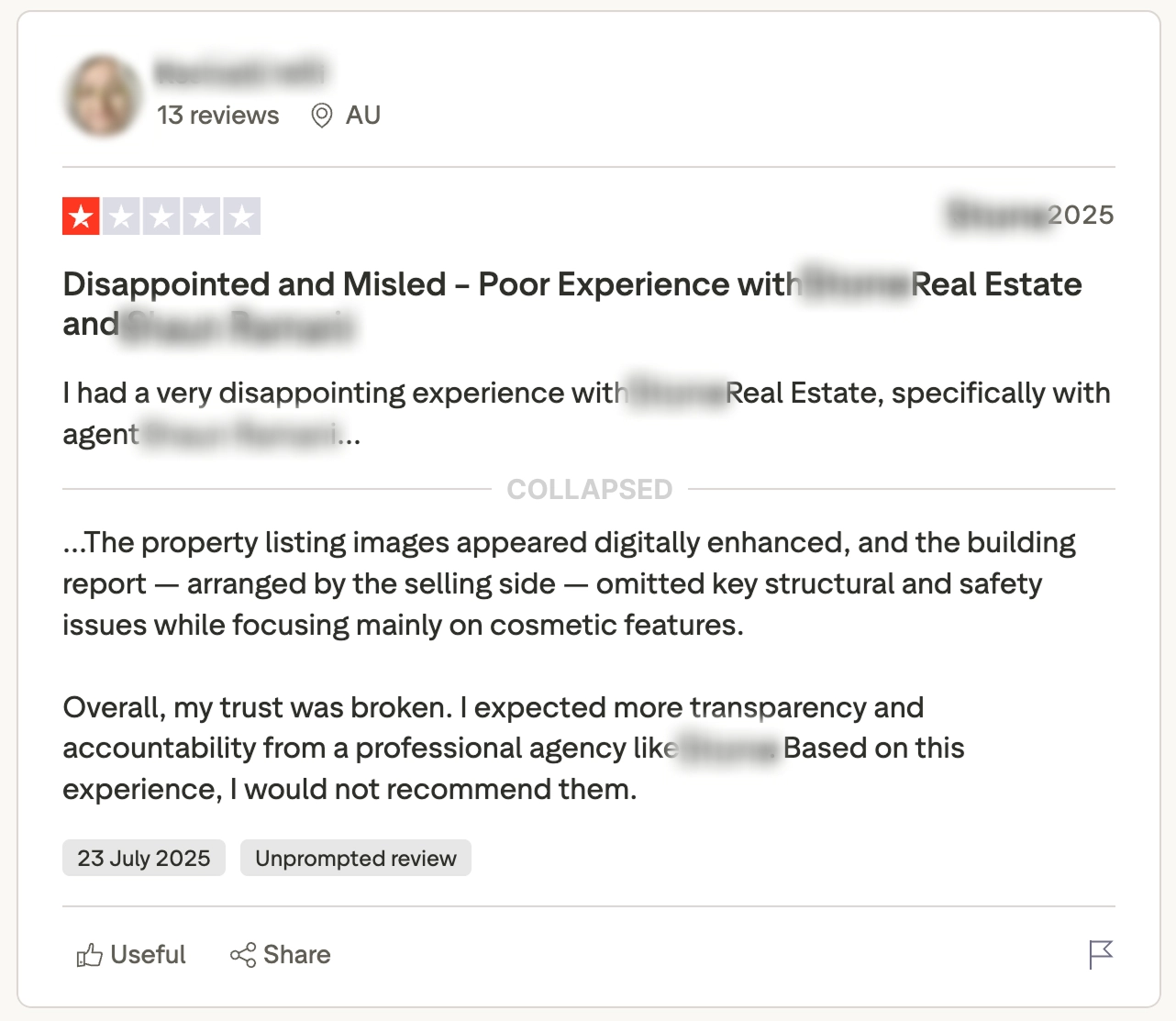
Now, you might be wondering why this buyer has become so frustrated with just a single property visit. To give you more context, she was from Australia, looking to purchase a property in the UK. And for her, a property visit meant flying for 17-28 hours. So yes, anyone would be frustrated in such a situation.
**Sorry, but we won’t provide the source link to this review to avoid tarnishing the reputation of any of the parties.
Even If You Honestly Use Real Photos, People Will Still Be Skeptical
So far, we’ve seen various reasons why buyers now view photos with a skeptical standpoint.
And to be honest, even if you hire a skilled photographer for the job and ensure your images reflect what’s in real life, they won’t meet people’s expectations entirely.
Simply put, a photo is a snapshot. Twenty photos are twenty disconnected snapshots, and the buyer has to stitch them into one single space in their head. Buyers actually try to imagine the property, such as “That’s the bedroom, I’d step out here into the living room, the ceiling will look about ten feet high.”
Every buyer guesses differently, so the same honest listing produces a different expectation for different prospects.
On top of that, photos also can’t carry scale or distance. So unless written down, people can’t tell if the ceiling is nine feet high and not eight, or that the kitchen is a longer walk from the garage than it looks. Buyers almost never get this right.
The Clear Pattern You Can’t Avoid
The pattern is consistent. Most buyers do not trust property photos, and a handful of bad realtors have taught them not to.
You didn’t create that reputation, but you’re the one selling against it.
What The Data Says About Virtual Tours – Do They Reduce Skepticism?
Now, as we mentioned earlier, if you search online or ask about it on public forums, many will recommend redesigning the listing page, recording a video of you walking on the property, or including a 360 virtual tour.
But interestingly enough, if you research the backgrounds of the people suggesting these, you will find out that most of them are either part of an agency or a tool that helps to execute their recommendations.
So, yes, it’s not something you can trust blindly. And we don’t want to make a claim based on that data at all.
Instead, we tried to look into independent research from vendor case studies and data from actual entities dealing with real estate.
The goal here is to find out if virtual tours are actually worth the investment and if they deliver better output compared to photos.
And to measure it, we decided on the criteria that would prove virtual tours to be more effective against the skepticism around photos. Specifically, we tried to find answers to the following:
- Do Virtual Tours Reduce Wasted Real Estate Showings?
- Do Virtual Tours Attract More Interested Buyers?
- Do Virtual Tours Help Close More Deals Or Increase Chances Of Selling Stale Listings?
Here’s what we found out.
Can Virtual Tours Reduce Wasted Real Estate Showings?
According to a report from Property Week back in the 2000s, using virtual tours helped reduce wasted real estate showings by up to 40%. Recently, an agency called Invision Studio validated this by tracking the listing performance of its clients for whom it built virtual tours. They stated that adding virtual tours reduced the no. of wasted showings by around 50% (from 8-12 showings to 4-6 showings).
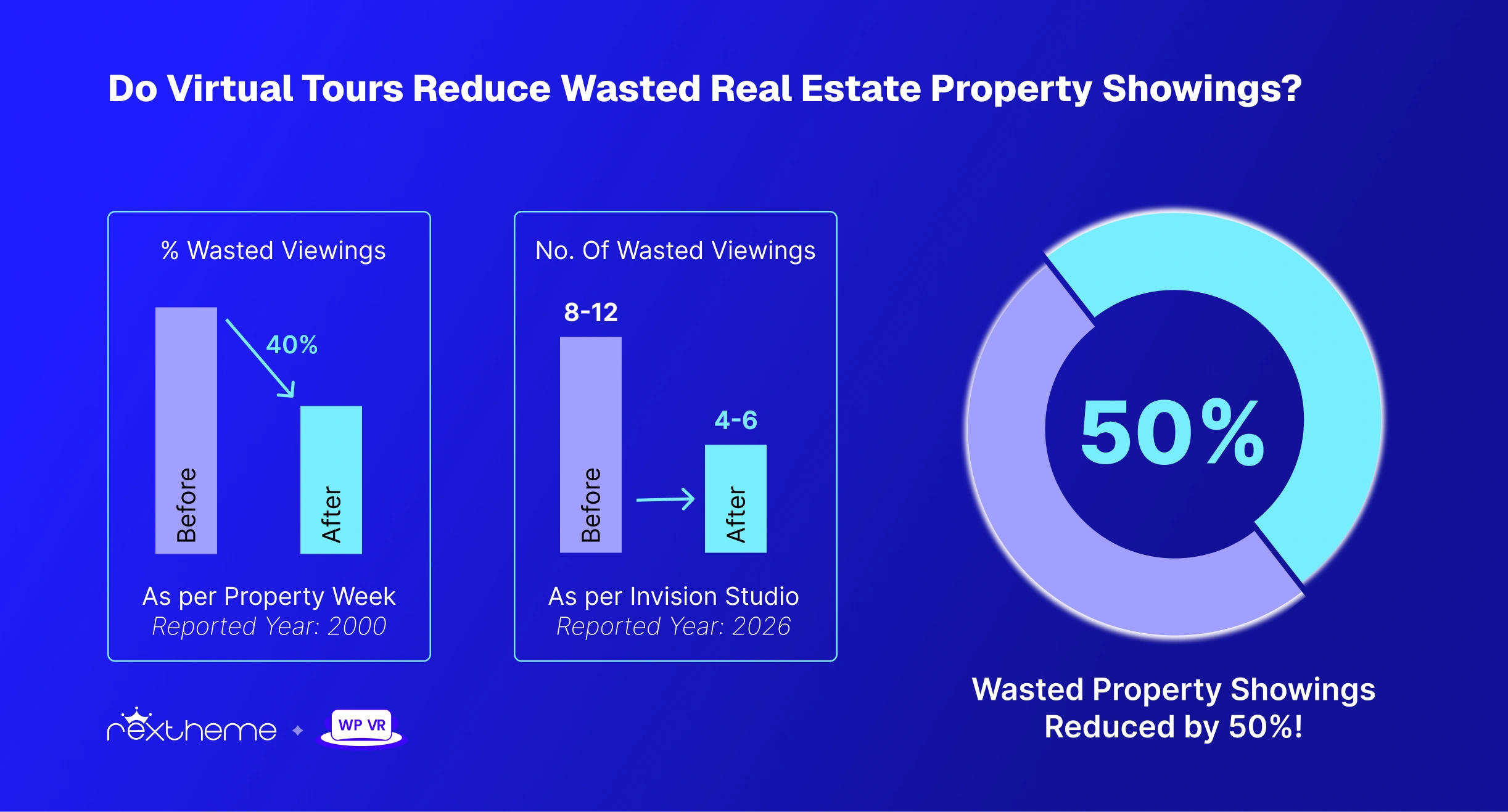
And this is probably the strongest benefit of using virtual tours. You would want visitors to be genuinely interested when they request a home visit; i.e., the right buyer would come along sooner.
Short Answer: Yes, virtual tours can reduce the number of wasted property viewings by 40-50%.
Do Virtual Tours Attract More Interested Buyers?
Realtor.com used its own internal platform data to deduce that listings with virtual tours got 87% more views compared to those with static photos. It just shows how buyers prefer VR technology over static visuals.
On the other hand. Matterport ran an industry study by collecting telemetry tracking data from their own platform users and used comparative analysis to determine that listings with 3D virtual tours get 95% more phone inquiries!
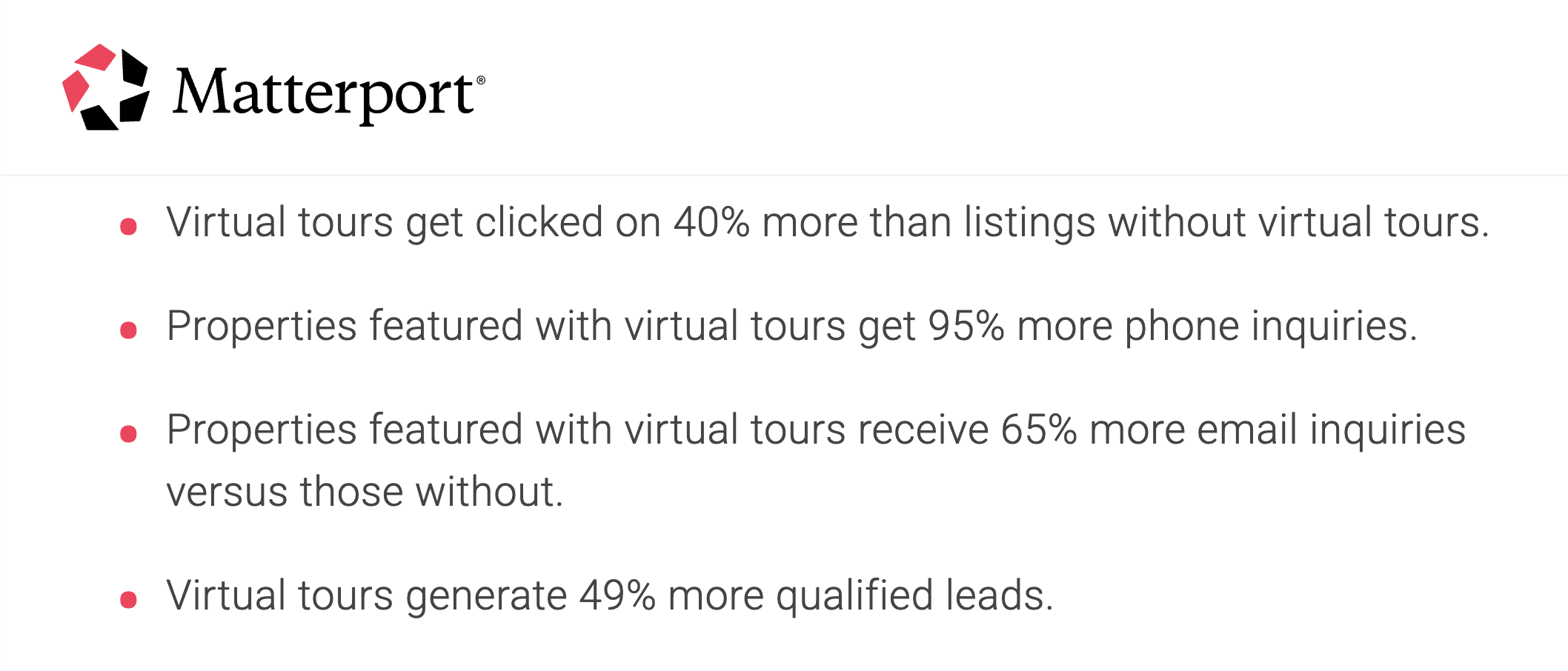
This is huge! More inquiries mean more chances of closing the deal. It’s a single metric that automatically makes virtual tours a crucial element to add to property listings.
Apart from this, Coldwell Banker, one of the oldest and largest residential franchises in the USA, ran a consumer survey and found that 77% of Americans wanted a virtual tour before they would even agree to visit a property in person.

People are aware that VR technology is now more accessible. So they simply expect it and often judge listings based on whether there is a virtual tour or not.
All of the above simply points to one thing: virtual tours definitely influence people into choosing listings.
Short Answer: Yes, virtual tours attract more interested buyers.
Do Virtual Tours Help Close More Deals?
So we’ve determined that virtual tours do reduce wasted real estate showings, and they help attract interested buyers. But all of those are just the lead measures. The lag measure of it all is how many deals you could actually close.
And we’ve found strong sources to determine this answer.
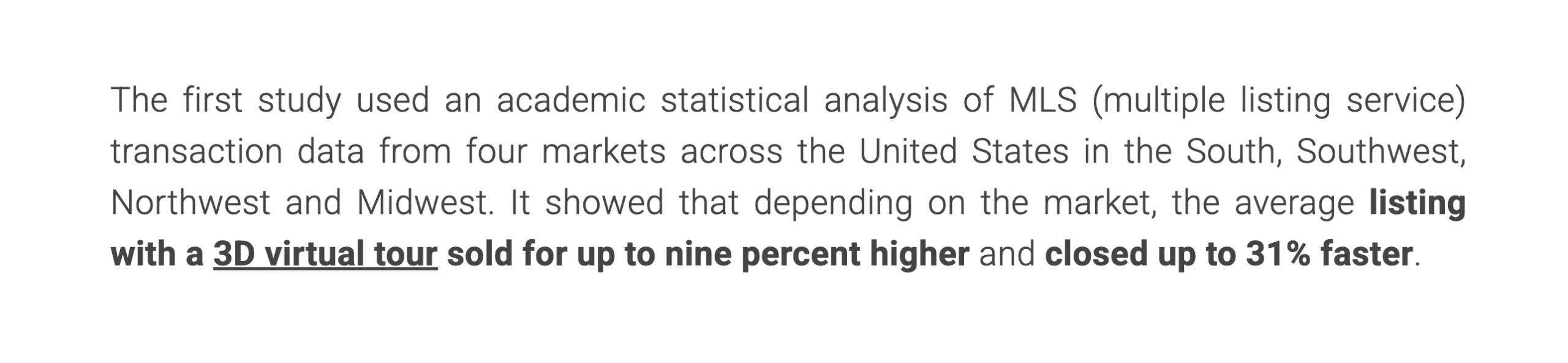
Researchers at Texas Tech University’s Rawls College of Business analyzed MLS transaction data across four US markets and more than 143,000 listings, comparing similar homes with and without a 3D walkthrough. Listings with virtual tours closed up to 31% faster and sold for up to 9% more in value.
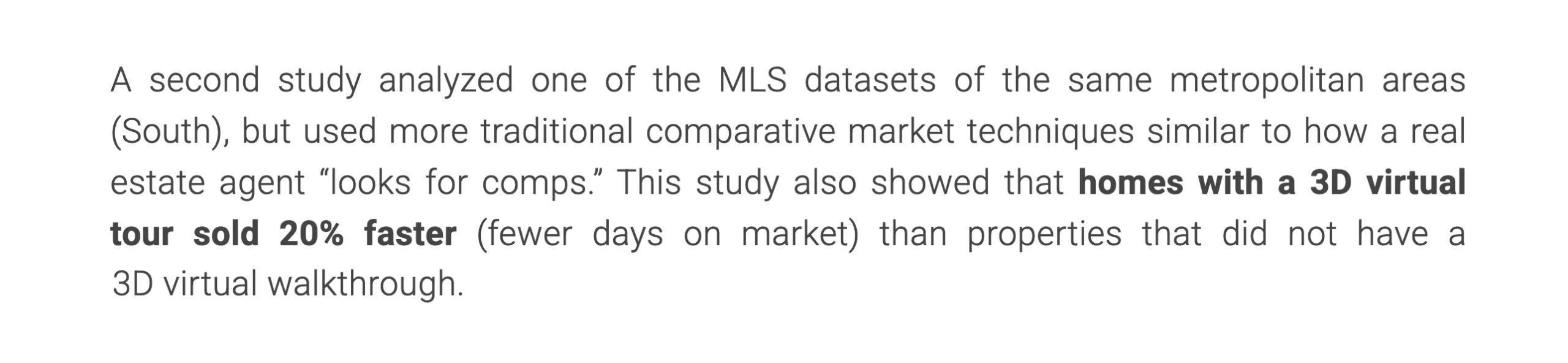
A second study by the same team, using different, more traditional comparative market techniques, reached a similar conclusion: homes with 3D tours sold roughly 20% faster than photo-and-video-only listings.
In another case, a Chicago commercial real estate firm called MetroSpace was going through a decline in sales and engagement. And if you look it up, they have a very strong portfolio. So the decline wasn’t due to reputation, and having stale listings wasn’t common for them.
One of the actions they took was to introduce virtual tours on their listings. Six months after rolling it out, they reported a 70% increase in property viewings and a 30% decrease in deal closing time. On top of that, they got 50% more inquiries from international clients, who’d never have physically visited otherwise.
Now, we are not saying virtual tours alone gave that result. They did improve their distribution strategies to reach buyers. But virtual tours did play a strong role in achieving these results and rejuvenating stale listings.
On the residential side, a property management group working with LCP Media reported that unit-level virtual tours drove 40% more leads and 72% more signed leases compared to photos and video walkthroughs alone.
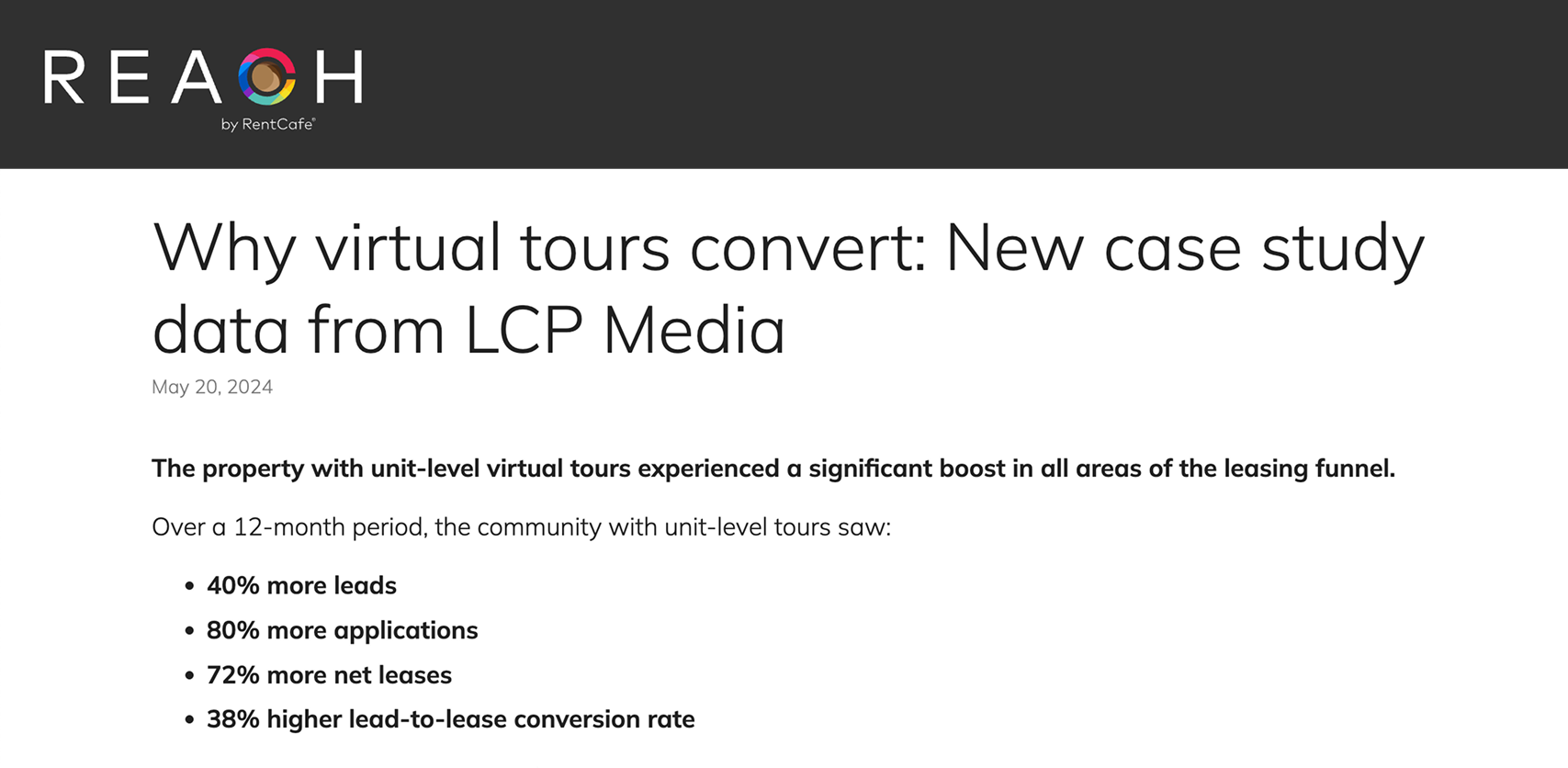
This data is based on traffic and conversion data from their own website.
So, you can see, two completely different companies with different property types and scenarios got the same benefits — more inquiries received and more deals closed.
From these, we can safely say virtual tours do help grab the attention of the right buyers, leading to more conversions.
Short answer: Yes, virtual tours can lead to more no. of deals closed, a higher number of inquiries, and reduced deal closing time.
Evidence Suggests Virtual Tours Help Build A Real Connection Between Buyers And Property
One more number we’d like to put up today is data from Nodalview, which usually tracks engagement for thousands of agencies
But we’re not bringing this up from a marketing perspective. Rather, we want to highlight this from a customer behavior perspective.
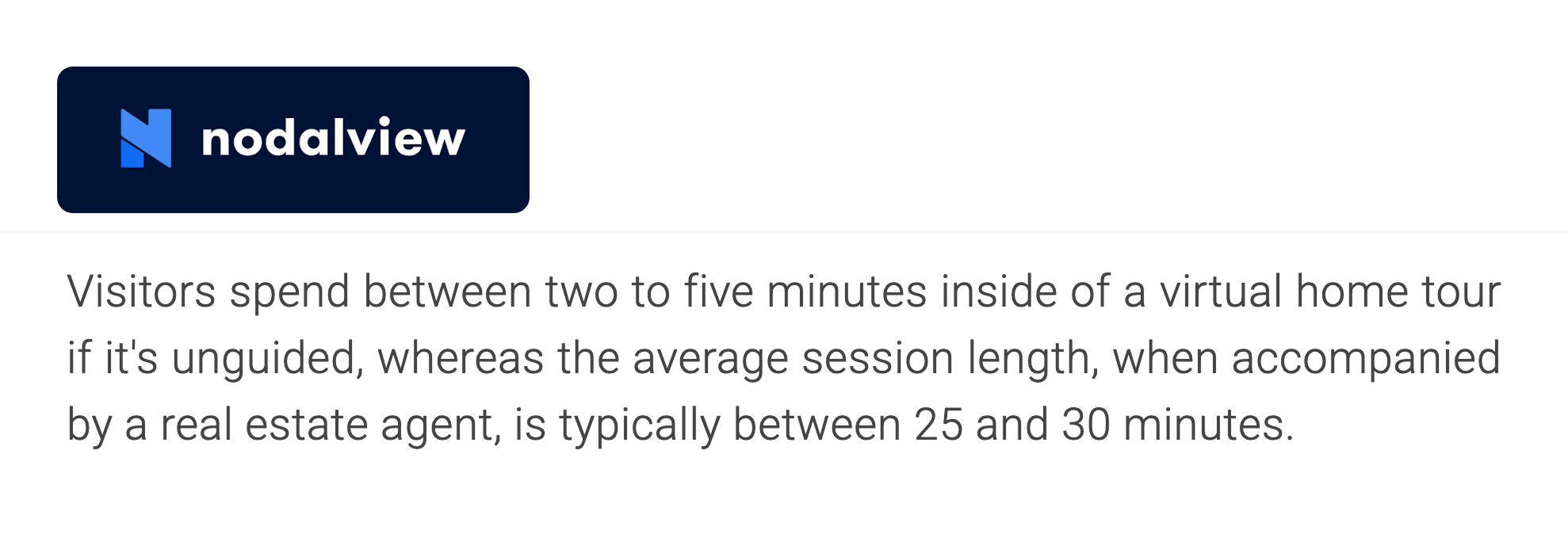
What Nodalview reported is that people spend 2 to 5 minutes on pages that have self-guided virtual tours, whereas on ordinary pages they spend less than 2 minutes.
Well, that’s more than enough time you need to walk through different rooms and go through the property at your own pace without anybody asking you anything.
If someone is spending that much time on the page, it means that they’re taking a thorough look. And getting an inquiry from such visitors means that they’ve really thought about it, understood the property’s whereabouts, and contacted you with genuine interest.
Now, the difference between this scenario and one with photos is that virtual tours do provide a realistic view of the house, giving a better idea about the layout, spatial distribution, directions, etc., so people won’t have much confusion about things like “Is the room large enough?” or “How are the rooms arranged? Getting a 3D view will help them build a more accurate expectation of the property.
In short: Photos show you the house. A virtual tour lets you understand it.
Obviously, this will only be true if you do not enhance the photos digitally (even though it’s easily possible to enhance 360 photos with AI). But if you take real photos and use them to create the virtual tour, then it would actually mean the person taking the virtual tour is getting a realistic experience. So when they call you for a property visit, there is no contradiction in expectations. They won’t be disappointed with mismatched expectations. You will now have a much higher chance of closing the deal if everything else checks out.
To be fair, a virtual tour still isn’t the real thing; you can’t feel the temperature of a room or hear the street through a screen. But it’s far closer to reality than a stack of disconnected photos.
Data Clearly Suggests Virtual Tours Largely Reduce Skepticism
Till now, we all agree virtual tours have resulted in a growth in property sales, or at least that’s what the numbers suggest based on the case studies discussed above.
None of the studies directly referred to “building trust,” but if more people are actually buying properties after getting a virtual tour, it is a possibility that they tend to trust virtual tours more than photos.
But we’ll be honest, there have been cases where people complained about digitally enhanced virtual tours, though compared to the skepticism around photos, the number is far too low.
We are not claiming that virtual tours will remove skepticism, but they have proven to have gained more trust compared to photos.
So Do You Stop Using Photos? No.
After getting all those negative perspectives about photos, you’d think we would recommend you stop using photos. But no. Photos and virtual tours do two different jobs.
First of all, a strong hero shot is still what makes someone stop scrolling and click into your listing. Once they are on the listing page, you can present the virtual tour plus a gallery of photos.
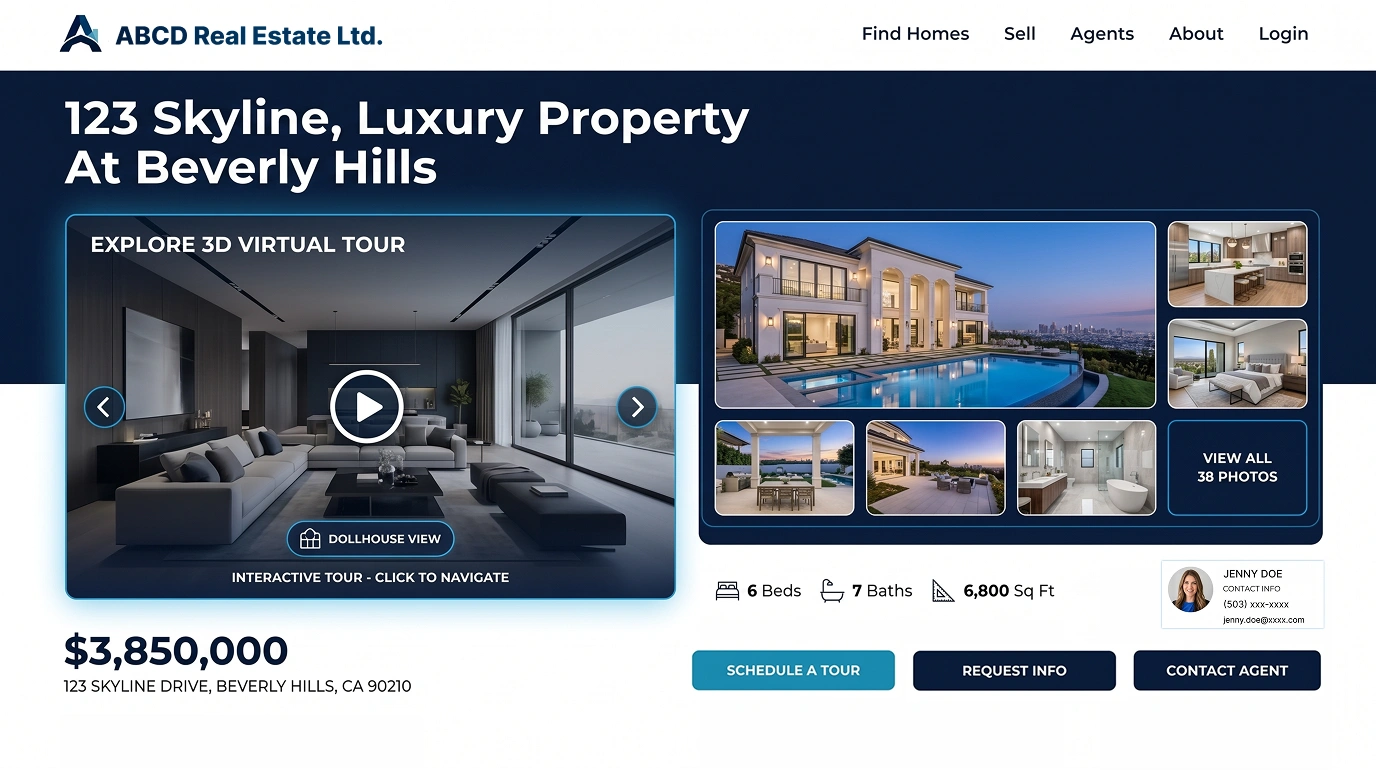
While a virtual tour sounds exciting, not everyone will have time to take a thorough tour of every listing. A good photo gallery will grab attention easily. Once they are hooked, they will take the tour and build up realistic expectations.
In short: Photos will hook the prospect. Virtual tours will set real expectations.
Putting This to Work For Your Listing Site
- Keep leading with a strong hero image on the listing directory.
- On the landing page of a listing, put the virtual tour prominently in the first fold, not buried below the fold, while keeping a photo gallery right below it or beside it. The galleries and the virtual tour should be the natural next action once someone is on the listing page.
- Let the tour be self-guided. The two to five minutes of solo exploring will help build genuine interest and help form realistic expectations.
- Include additional details within the tour where possible. For example, flooring material, roof tile materials, etc.
- Make it possible to submit inquiries during the tour.
- When someone inquires, treat their questions as real. They’ve already cleared the “does this feel right” hurdle, so your job shifts from selling the space to closing on specifics.
That’s the whole shift: setting expectations earlier, rather than waiting for the visit when it’s too late and emotions are high.
Our Verdict: Are Virtual Tours Worth It? And Should We Stop Using Photos?
So, back to the actual question. Does a virtual tour actually get more people to trust your listings and build genuine expectations over photos?
- Based on all the evidence from forums and real stats, we can safely say people do not fully trust photos.
- Virtual tours, however, seem to have always contributed to positive growth in results when used. Most stats and claims suggest that virtual tours can reduce wasted showings, attract more buyers, and help close more deals faster.
In short: Yes, virtual tours are worth the investment.
However, as explained in the previous section, even if you use virtual tours, do not stop using photos. They play their own role in hooking customers.
Myths About Virtual Tours You Should Stop Believing In
There are a few myths about virtual tours, which is why many realtors do not use them. If any of these is your reason, then it’s time to change that.
Myth 1 – Virtual Tours Are Expensive
A few years back, when Matterport was the only option, yes, virtual tours used to be expensive. You needed a professional setup, maybe hire a VR agency, or get an expensive VR tool.
But now, you will find several virtual tour software that are very affordable. For example, if you use a WordPress site, you will find our tool called WPVR, which you can start using for free and later upgrade for as low as $8.25/mo (billed annually), depending on your use case.
Question: Are virtual tours expensive in 2026?
Answer: No, virtual tours aren’t expensive anymore. You can build them for free with tools like WPVR, and even get premium features at as low as $8.25/mo.
Myth 2 – It’s Technically Complex and Time-Consuming
You’d think creating virtual tours would take hours. But fast forward to today, if you just have 360 panoramic images, you can create virtual tours in as little as 5 minutes.
Referring to WPVR again, you can actually have a working virtual tour ready in just a few minutes.
Question: Are virtual tours complex to build or time-consuming to create?
Answer: No, creating virtual tours is no longer complex. Modern tools (like WPVR) simply need you to provide 360 panoramic images (which you can even capture with a phone), and you will have a working 360 virtual tour ready in as little as 5 minutes.
Myth 3 – They Only Work For Luxury, High-end Listings
This one is actually very common. Many realtors believe that since they are not selling luxury homes, virtual tours are not worth the effort.
But in 2026, you have to understand that people expect virtual tours (as per Coldwell Banker’s survey mentioned above).
And besides, Zillow and the major listing portals have normalized tours to the point that browsing one is now the default, not a bonus.
So, for any type of property you sell, a virtual tour will definitely add value in getting more potential buyers.
Question: Should we use virtual tours for regular listings or are they just for luxury homes?
Answer: Using virtual tours is now the default requirement for any listing, whether it’s a regular home, rental apartment, or a luxury home. Since VR tools are now easily affordable and people are used to VR tech, adding one will give you more authority and increase your chances of selling more homes.
Can Virtual Tours Replace A Real Visit?
To be very direct, no. Nothing can replace a real visit.
That is why, throughout this investigation, you saw that we always mentioned virtual tours as a supporting tool to build up real expectations in the buyers’ minds. But you will never hear anybody claiming that a virtual tour alone can actually close a deal.
What a virtual tour does for you is it reduces the effort you would need a few years back trying to convince buyers over the phone and via photos or videos. At the same time, it ensures you won’t have to worry about mismatched expectations when prospects come for a property visit.
Besides, logically speaking, why would someone make such a huge investment without viewing the property first? No matter how realistic your virtual tour may be, the decision will ultimately come after a live visit.
Try Adding A Virtual Tour On At Least 1 Property Listing
Now that we have cleared everything up, we just wanted you to give it a chance for your listings.
If you have a WordPress site, use WPVR. It’s a free virtual tour creator, so it’s more convenient. In case you do not use WordPress, you may try out a SaaS VR tool like Pano2VR or CloudPano.
Or, you can always get a WordPress site set up just to build & host virtual tours via WPVR, and then use its embed feature to place it on your main non-WordPress site.
Here’s what you should do next:
- Find out a listing that gets traffic but has a very low number of inquiries.
- Invest a few minutes to capture 360 photos of it and upload them to the VR tool (like WPVR).
- You will have a virtual tour ready in just a few clicks.
- Place the tour on the listing page.
- Two weeks later, compare the data to see if you now get more inquiries and more people spending time on that page.
We are sure you won’t be disappointed.
To conclude:
Photos alone won’t do you justice, because buyers are very skeptical about authenticity. Rather, use virtual tours as the main representative of the house to give a realistic experience, leading to reduced wasted property viewings and more deals closed.
Summary Of Our Findings
| # | Question | Answer with Stats | Source |
|---|---|---|---|
| 1 | How many showings does it typically take to sell a house? | It normally takes 10–25 showings before someone makes a serious offer | PropertiesCT |
| 2 | Can buyers always tell what they’re looking at in a listing photo? | No. One forum thread showed a couple who couldn’t tell whether a photo showed the front or back of a house, because it sat so oddly close to the road. | TractorByNet |
| 3 | Do agents deliberately leave out details in listings? | Some buyers believe they do. One individual compared listing photos to dating profiles, saying agents don’t lie outright but quietly omit details; he called it “willful ignorance.” | TractorByNet |
| 4 | How important is transparency to buyers? | It’s super important, and not doing so can hurt buyers’ trust. A buyer reported losing trust in an agent who wasn’t transparent about what was included in the contract. | BiggerPockets |
| 5 | Can property photos be deceiving for buyers? | In some cases, yes. A buyer described driving 40 minutes to see a “spacious” bedroom that turned out to be 9×9 feet, exaggerated by a wide-angle lens. | Benzinga |
| 6 | Why are some states now regulating digitally edited real estate photos? | Some states now require disclosure if listing photos have been digitally edited. | Florida Realtors |
| 7 | Can digitally edited photos mislead buyers about a property’s real look or view? | Yes. A realtor recounted clients who backed out after discovering a “lakefront” home was actually across the road from the lake, with the view half-blocked by a neighbor’s house, once photos were digitally enhanced. | Florida Realtors |
| 8 | Do real estate agencies get negative reviews over misrepresented photos? | Yes. A UK agency received a one-star Trustpilot review from a buyer from Australia, who felt deceived by digitally enhanced photos and said she’d never work with them again | Trustpilot |
| 9 | Can virtual tours reduce wasted real estate showings? | Yes. Virtual tours have proven to help reduce wasted showings by 40% (as per data from the year 2000). | Property Week |
| 10 | How much do virtual tours help to reduce dead property viewings in 2026? | As per Invision Studio, virtual tours can help to reduce wasted property viewings by 50% (as per data from 8–12 showings down to 4–6 showings). | Invision Studio |
| 11 | Do listings with virtual tours get more views than those with static photos? | Yes. Listings with virtual tours get 87% more views compared to static-photo listings, per Realtor.com’s internal platform data. | Snappr |
| 12 | Do listings with 3D virtual tours get more phone inquiries? | Yes. Listings with virtual tours get 95% more phone inquiries. | Matterport |
| 13 | Do buyers expect a virtual tour? | Yes. 77% of Americans wanted a virtual tour before agreeing to visit a property in person. | Samsung Insights |
| 14 | Do listings with 3D walkthroughs close faster? | Yes, across 143,000+ MLS listings in 4 US markets, homes with 3D walkthroughs closed up to 31% faster. | Rawls College of Business |
| 15 | Do listings with 3D walkthroughs sell for more? | Yes, according to Rawls College of Business, they may sell for up to 9% more. | Rawls College of Business |
| 15 | Do listings with virtual tours close faster? | Yes. A second Rawls College study, using different comparative market techniques, found homes with virtual tours sold 20% faster than listings with photos and videos only. | Rawls College of Business |
| 16 | Can virtual tours increase property viewings for stale listings? | Yes. MetroSpace had stale listings for a while. Then they introduced virtual tours and got a 70% increase in property viewings within six months. | MetroSpace |
| 17 | Can virtual tours help increase deal closing time when selling homes? | Yes, it can help reduce deal closing time by 30%. It worked for MetroSpace. | Momentum 360 |
| 18 | Do virtual tours help reach international buyers? | Yes. MetroSpace got 50% more inquiries from international clients who’d never have physically visited otherwise. | MetroSpace |
| 19 | Can unit-level virtual tours help generate leads for residential listings? | Yes. Residential listings with unit-level virtual tours can get 40% more leads compared to ones with photos and videos only. | ReachByCafe |
| 20 | Can unit-level virtual tours help with getting leases signed? | Yes. Residential listings with unit-level virtual tours can get 72% more signed leases compared to ones with photos and videos only. | ReachByCafe |
| 21 | How long do visitors spend on pages with self-guided virtual tours? | People spend, on average, 2–5 minutes on pages with virtual tours, vs. under 2 minutes on ordinary listing pages. | NodalView |
| 22 | Are virtual tours expensive in 2026? | No. Virtual tours are now very affordable. Tools like WPVR offer a free tier, with premium features starting as low as $8.25/mo (billed annually). | RexTheme |
| 23 | Are virtual tours complex or time-consuming to build? | No. With most modern virtual tour creators like WPVR, you can create a virtual tour in under 5 minutes. Capture 360 photos (with a phone or 360 camera) → Upload to software → Get a ready virtual tour. | RexTheme – WPVR |
| 24 | Are virtual tours only useful for luxury, high-end listings? | No. With 77% of buyers wanting a tour before visiting, virtual tours are now the default expectation across all listing types, not just luxury homes | ColdWell Banker |
Question For You:
Having covered all of that, here’s a question for you that we’d love to hear about in the comments.
- Do you use virtual tours?
If yes, can you share how effective they are for you in the comments?
If not, can you share any particular reason you are not using one yet?
Or you can simply share your thoughts and opinions on the topic as you read it.
Cheers!