![What Amazon Knows That Most Woo Stores Miss [2026]](https://rextheme.com/wp-content/uploads/2026/04/Amazons-Secret-To-Profitability.png)
Did you know you could add 10–30% extra revenue, all on profits, without touching ads or increasing traffic?
As an eCommerce store owner, you’d think you could grow your profits by doubling down on traffic, right? WRONG!
More visitors don’t mean more profits!
You could run more ads, use SEO, or list products on several online marketplaces to reach more buyers. But that doesn’t guarantee profits! In fact, it’s possible you are simply lowering your margins over time. (I’ll explain in a bit.)
But then, how are large brands like Amazon growing exponentially?
Is it because they have huge traffic and can spend a lot on ads? NO. That’s not why Amazon is so profitable.
Jeff Bezos has found a secret to profitability that has led Amazon to become a multi-billion-dollar company, that too, with high profit margins!
And it’s so simple that after today, you’ll be like, “Why didn’t I think of this earlier?”
But before I shed light on that, let me first explain why you might be lowering your margins over time!
The “Leaky Bucket” That’s Eating Away Your Profits
I’ve seen this a lot of times, and I’m sure you can relate…
Most WooCommerce store owners, when they want to grow, ask the same question: “How do I get more traffic?”
But guess what, that is the wrong question to ask, because no matter how much water you pour into a leaky bucket, it will keep on losing water.
What does that mean?
Picture this:
Suppose your WooCommerce store is a bucket.
You do everything you can to pour in traffic!
- Optimize your product data feeds,
- Expand to new marketplaces,
- Do more SEO to get organic traffic,
- Increase your ad spend, and so on.
But with your default WooCommerce setup, 70% of the time, people abandon the cart.
And for the remaining buyers, each customer places one $20-$30 order and leaves. That’s it.
You’d be surprised to know, these buyers would happily spend $10-15 more if you had a better setup!
Now, what do you do if you want to increase revenue? You invest more in traffic, and they enter the same “leaky bucket” store, leaving you with the same LOW PROFIT MARGIN!
You pay to acquire customers. You do the hard work. And then you leave value sitting on the table at the very last moment.
So, how do you plan to get out of this?
This is where Amazon has already found the solution for you!
The Secret To Profitability For Amazon’s 200 Billion Extra Earnings Per Year!
Think about the last time you went to Amazon to buy one item, like a charger, a book, or a phone case.
But by the time you checked out, your cart had three or four items, right?
Well, it’s not by chance. It’s Jeff Bezos strategy that never lets you check out with just one item!
You go to a product page, and you see “Frequently bought together” suggestions.
You view your cart, you see “People who bought X, also bought Y.”
You visit your profile, you see “Recommended for you”, which you often find very tempting to order.
All these are so simple, right?
But these are part of Amazon’s famous “Recommendation Engine” that made them so profitable!
In 2013, a research report by McKinsey stated that Amazon earned 35% additional revenue just by using its recommendation tactics!
So yes, they did have more traffic than you. But what Amazon did (that you probably haven’t yet thought of) was that they made sure, on average, every buyer would spend an extra 35% per order!
That’s a huge chunk of their total revenue that they earned without investing in more traffic or ads, meaning an instant growth in profits!
The Bottomline: Focus On Increasing Average Order Value (AOV)
Why did these simple recommendations work so well?
To you, it may seem like mere recommendations using some complex algorithm. But actually, it’s all about psychology!
What Amazon did was they took advantage of several psychological patterns of any human being. Here are four of their most effective ones:
- Mental Accounting
As per Nobel Prize-winning economist Richard Thaler, mental accounting is the idea that once a purchase has been mentally “approved,” adding a small, related cost to the same transaction requires almost no re-evaluation.
- Foot-in-the-Door Technique
It is a psychological strategy used to persuade people to agree to a particular action, based on the idea that if a respondent complies with an initial request, then they will be more likely to agree to more requests moving forward.
- Impulse Buying Mentally
Impulsive buying is an unplanned, spur-of-the-moment decision to purchase goods or services, driven by sudden urges, emotions, or promotional stimuli rather than logic or necessity.
- Convenience
The psychological tactic of convenience involves designing experiences, products, or situations that minimize effort, decision-making, and friction for the user, making a desired action (like purchasing or complying) the easiest path of least resistance.
So, they were not random suggestions or offers. They were all part of Amazon’s psychological tactics.
You will always find relevant suggestions that are hard to ignore while you are purchasing products on Amazon.
There several other large brands leveraging these same psychological tactics. For example, you will rarely find yourself walking into IKEA for a lamp and not leaving without a bag full of tea lights, a new colander, or more items.
| The Two Main Factors That Set Amazon Apart From The Rest | |
| High Focus On Increasing Average Order Value Amazon’s recommendation engine is all about making every buyer spend more on every order. They didn’t get profitable with more traffic or ads. The secret is earning extra from every buyer! | Proven Psychological Tactics That Multiply AOV In their mission to increase average order value, they carefully built a system where they manipulate or influence buyers to add more products to the orders without them even realizing the whole setup. Buyers feel it’s a natural journey and feel proud of owning their decisions. But secretly, it was all planned by Amazon! |
Now comes the real question. How can you use these tactics to your advantage in WooCommerce?
Can You Adopt The Same Strategies In WooCommerce?
You have to understand that Amazon’s recommendation engine was built over 13 years ago. In 2026, the same “Frequently Bought Together” or “People Also Buy” tactics aren’t as effective.
But the same concepts as Amazon are still the key to eCommerce profitability:
- More focus on increasing AOV
- Leveraging proven psychological tactics
Don’t worry. Today, we have more modern ways to achieve these, and it is very easy to implement in WooCommerce.
- Use Order Bumps At The Checkout
An order bump is a small product offer you place right on the checkout page, which people can click to add to their order easily. They don’t have to browse the product again or leave the checkout page at all.
You add small details there that they can read and decide if they want to purchase it.
It can be a complementary product, an add-on, or a “frequently bought together” product placed as an order bump.
For example, suppose you sell sneakers.
A buyer has a pair of sneakers in the cart, worth $100, and is on the checkout page to place the order.
But there, he finds a quick bump offer on 3-pairs of socks at $20 instead of $25 (a small $5 discount).
This feels naturally relevant, and many people will add it to the order. Meaning, you will make an extra $20 right then and there.
If done right, it will trigger the same psychological aspects as Amazon did, and lead to people spending extra on every order! You could end up getting a 10-30% lift in AOV!
- One-click Upsell Offer After Checkout
An even more effective strategy today is a one-click upsell offer, which highly leverages the foot-in-the-door technique.
The buyer has already made a purchase. You’ve already made money. But instead of ending the journey, you take them to a sales page where they get an exclusive offer on a related product or an upgrade to what they have already bought. And this, they can accept purchasing with one click (convenience)!
If you have the right offer in place, you could earn over 25% more just with this single strategy. (We’ve used it ourselves to get this result.)
For example, suppose a buyer just ordered a couple of books for $40. Right after checkout, he gets a special 30% discount on a bundle of 6 books from the same genre, priced at $84 instead of $120.
If the buyer is a book lover, then he will take the offer, making you an additional $44!
Amazon’s profitability isn’t just about order bumps and upsells — it’s also about being everywhere buyers search. If marketplace expansion is on your radar, here’s how Walmart Marketplace vs Amazon compares for WooCommerce sellers.
What The Numbers Actually Look Like If You Adopt Both Strategies
Let me walk you through a hypothetical scenario that shows exactly how this plays out in practice.
Imagine a WooCommerce store selling yoga mats with an average order value of $35. And let’s say they have lovely products, loyal customers, and a decent organic traffic. But their growth has stopped.
Now, the owner has two choices:
- Increase Ad Spend to get more visitors
- Look for an optimization opportunity.
Instead, she adds a single Order Bump at checkout: a $10 yoga mat cleaning spray. Just a small checkbox right above the “Place Order” button that reads: “Add a mat cleaning spray to your order — keep your mat fresh. Just $10.”
And right after checkout, she set up a special upsell offer page for a complete Yoga accessories set, including Yoga blocks, straps, mat, drinking bottle, and a cleaning spray, all bundled at the price of $120 instead of the regular $150.
Think about what these offers actually are. They are not random products offered. There are three things at once:
- A problem they didn’t realize they had
They just bought a mat, and somewhere in the back of their minds, they know it’ll need cleaning. She just solved it before they had to go searching. - A convenient item they likely would have bought anyway
Eventually, the customer would need the cleaning spray and the rest of the set. Maybe they wouldn’t buy it today. But they would buy it for sure later on. - A natural complement
The products offered go naturally with the main purpose of the buyer.
And all in all, they both trigger the 4 psychological triggers Amazon leveraged for years!
If a buyer goes through the whole process, the owner could end up earning up to $120 from each buyer!
If they had 100 orders last month earning $3500, this month they would earn over $4500!
“But Won’t It Annoy My Customers?”
I know what you might be thinking right now. I’ve heard it quite a few times: “This feels salesy. I don’t want to come across as pushy. My audience is different.”
Here’s the thing. I felt that way once, too. And then I looked at the data.
Customers don’t resent well-placed offers. They resent irrelevant ones.
The difference between “pushy” and “helpful” is a single word: relevance.
An order bump at the checkout that says “add a $10 mat cleaning spray to the order” to someone already buying a $35 yoga mat? That’s not pushy. That’s thoughtful curation. It’s similar to a knowledgeable shop assistant saying, “Oh, and you might also need this.”
So being able to offer the right product is important.
But the default WooCommerce checkout may not be able to help you with that.
Then what’s the solution? Let’s see.
How To Implement Order Bumps & One-click Upsells In WooCommerce To Become Profitable Like Amazon?
Now that you are all set in understanding the simple yet big secret to profitability that made Amazon billions, you too should take steps to implement this strategy.
You’d be happy to know it’s actually really easy to use order bumps and one-click upsells in WooCommerce.
All you need is a plugin that is built to implement these strategies and works natively with WooCommerce.
We recommend you use WPFunnels.
The plugin naturally works with WooCommerce. It will let you customize the default WooCommerce checkout process into a more conversion-optimized one.
- You’ll be able to use proven checkout-form templates aimed at reducing drop-offs.
- Add conditional order bumps based on product category, specific products, cart total, etc.
- Make one-click upsell offers after checkout based on products in the cart.
- Create separate sales funnels for products to run exclusive campaigns.
You can actually get started with it for free.
It’s Time To Become a Different Kind of Store Owner.
I want to close with something bigger than tactics, because I think the real shift here isn’t about WooCommerce plugins or AOV percentages.
It’s about how you see your store.
The store owners who grow fastest aren’t necessarily the ones with the best products or the biggest ad budgets. They’re the ones who think deeper about the customer journey. They treat every step of the purchase path as something to be optimized for conversions and revenue growth, not just left to chance.
“Amazon didn’t get to half a trillion dollars in revenue by finding more customers. They got there by making every customer worth more.”
And you, too, should shift your mindset in that direction.
Jeff Bezos already proved that you could become more profitable if you are just smart about closing the leaky bucket of your store and making buyers spend more.
You can do the same thing. Right now. In your WooCommerce store, without new ads, a new product line rebranding, or a funnel overhaul.
You just need to stop treating checkout as a finish line and start treating it as the most valuable 30 seconds in your customer relationship.
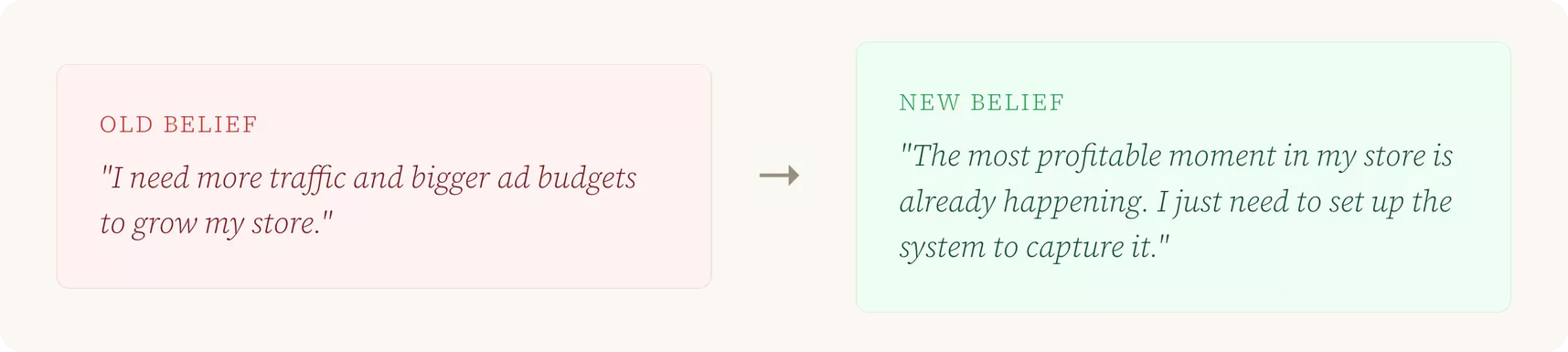
So here’s the direction you should follow moving forward:
- Optimize your store for a higher average order value.
- Next, focus on reducing drop-offs from the checkout page.
- Then, work on increasing your overall conversion rate.
- Once all of the above is covered, you can double down on traffic to get higher revenue and increase profit.
In the long run, you could be the owner of the next big eCommerce brand that everyone looks up to.
Ready To Scale Up Your Profitability Like Amazon Did?
If you are not in a hurry, let’s help you start using order bumps in your WooCommerce store right away with WPFunnels. It takes less than 5 minutes.
(Free version available)

![Show Your WooCommerce Products on ChatGPT & OpenAI Ads with Product Feed [2026] 2](https://rextheme.com/wp-content/uploads/2026/08/Show-Your-WooCommerce-Products-on-ChatGPT-with-OpenAI-Product-Feed-1-407x213.webp)
How can you help me implement this on my website and how much would it cost me?
Hi, if you have a WooCommerce website, you can actually implement this on your own using the plugin WPFunnels.
You may take a look at it here: WPFunnels (Exclusive for RexTheme users)
What you needs is to understand what products to offer as order bump or upsell based on what the buyer is willing to purchase. The best practice is to set up conditions to show the offers based on product category or specific product that the buyer has in the cart. That way, you can make relevant offers that work psychologically like what Amazon leverages.
If you need help, you can reach us via support. We can guide you on how you can implement these using WPFunnels without worrying about hiring external devs.
Thanks.