Running your own listing site in 2026 is… weirdly frustrating. You’re getting traffic, you’re getting calls, but half the time, the questions are basic. “Is it still available?” “What’s the last price?” You’ve heard it all before.
And then there’s the part that really gets you: buyers show up, walk through the place, smile politely… and vanish. Weeks later, you’re still wondering why that perfect-looking listing didn’t convert.
Here’s the thing: 97% of home buyers use the internet as their primary way to look for homes. That means most of your visitors are already interested but only if you can capture their attention the right way.
This guide isn’t about gimmicks or chasing the latest social media fad. I’m talking about Real Estate Marketing Trends that directly improve lead quality, get people engaging with your listings, increase inquiries, and ultimately help you close more sales.
By the end of this post, you’ll have a clear sense of what’s actually working in 2026 and how to take action without wasting time on trial and error.
TL;DR: 10 Real Estate Marketing Trends for 2026
Trend 1: Virtual tours that filter serious buyers
Trend 2: Short videos that bring qualified visitors
Trend 3: Lead pre-qualification as part of your marketing
Trend 4: Hyperlocal SEO to attract leads
Trend 5: Speedy responsiveness to inquiries
Trend 6: AI-powered personalization
Trend 7: Listing pages structured like landing pages
Trend 8: Proof-based marketing using reviews, stats, and engagement metrics
Trend 9: Using social media as a distribution channel
Trend 10: Virtual reality and interactive tours expanding into commercial listings
Why Real Estate Marketing Feels Harder in 2026 (Even If You’re Doing “Everything Right”)
Even if your listings look polished and you’re posting regularly, getting high-quality leads feels tougher than it used to. The market’s crowded, and almost every agent is on the same platforms with similar listing photos. So standing out isn’t about being everywhere but about being clear and building trust with the people who actually reach out.
Buyers these days are picky and move fast. They scroll through multiple properties in minutes and expect transparency right away. What matters now isn’t just grabbing attention; it’s giving the right details so they feel confident before they even book a visit.
The New Buyer Behavior You Need to Market For
To keep up, you need to see things from your buyers’ perspective.
These days-
- They’re doing most of their homework online before even picking up the phone.
- They’ll skim through 5–10 properties in minutes
- They decide to book a visit based on how clear and trustworthy your listing feels, not how flashy it looks.
- They want proof upfront and transparency on everything that matters.
If your listing doesn’t answer the key questions right away, it’s easy to lose them before they even call. That’s why understanding these habits is the first step to getting better-quality leads.
What These Real Estate Marketing Trends Actually Help You Do
When you start matching your marketing to how buyers behave now, you’ll notice a real difference:
- You’ll get fewer low-intent inquiries that waste your time
- More leads will be ready to book a visit from the start
- You’ll avoid mismatched home visits where expectations don’t line up
- You build credibility without having to become a “personal brand influencer.”
This is the setup for the trends ahead. Each one is meant to help your listings stand out, bring in more serious inquiries, and ultimately close more deals.
10 Real Estate Marketing Trends To Use In 2026 (With Real Implementation Tips)
Before I dive in, I want to be clear! This isn’t a list of random marketing ideas you scroll past on social media.
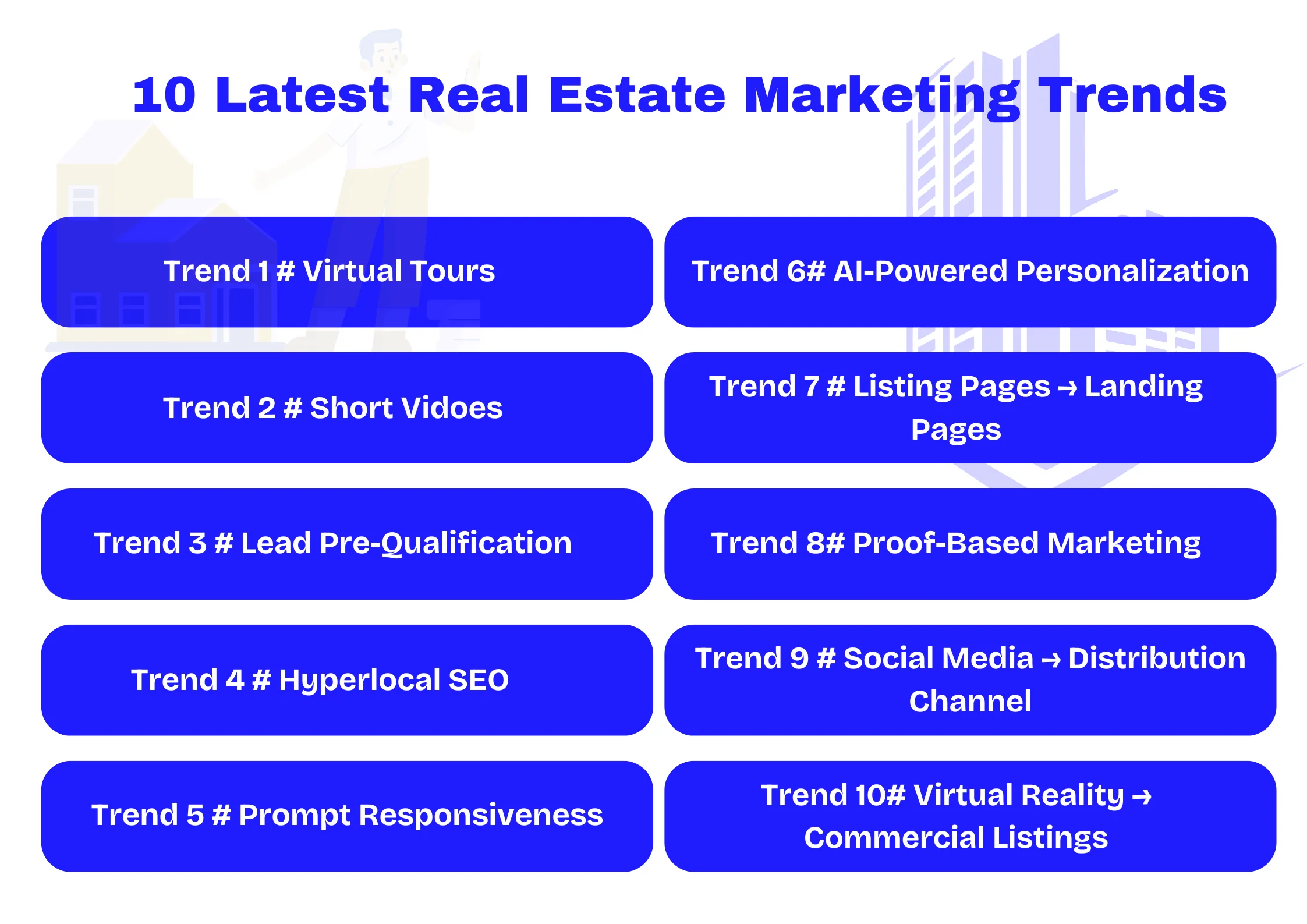
These are trends you’ll see working over and over for top agents and teams, and each one ties directly to better leads, more serious inquiries, and fewer wasted visits.
Trend 1: Virtual Tours That Instantly Filter Serious Buyers
If you’re still treating virtual tours as a “nice-to-have,” it’s time to flip the script. In 2026, they’re not about impressing buyers—they’re about helping them decide if a home is right before they show up. Think of it as a way to filter serious buyers from everyone else.
Why This Trend Matters in 2026
Buyers these days don’t want surprises. They scroll through multiple listings, comparing details, and often skip properties that aren’t crystal clear online. A virtual tour gives them the confidence to book a showing or pass, without wasting your time.
How to Apply It on Your Listing Site (No Code)
- Put the virtual tour front and center, above the fold
- Add a “Start Tour” button so visitors know exactly where to click
- Include a short intro video inside the tour to highlight key features
- Drop in hotspots for things buyers ask about: materials, renovation date, view, parking
- If you want to create a virtual tour on WordPress easily, try out WPVR
What This Fixes for You
- Fewer calls just asking “Is this still available?”
- Fewer wasted visits from buyers who weren’t serious
- More visitors who actually schedule showings
- Learn why virtual tours are beneficial for real estate: 10 Special Benefits of Virtual Tours for Real Estate
- Also, read this detailed guide: Virtual Reality for Real Estate: A Comprehensive Guide [2026]
Trend 2: Short Videos That Bring the Right Visitors to Your Listings
Once your listing page looks solid and your virtual tour is in place, the next step is getting the right people to actually reach it. Because a great listing doesn’t help much if buyers never land on it in the first place.
That’s where short-form video starts doing great work in 2026. It’s one of the fastest ways to get attention, build interest, and move people toward your listing page or tour. And it’s not just a real estate marketing thing either.
66% of marketers believe short-form content is the most engaging format, which tells you exactly why this format keeps winning.
What Works in 2026
Here’s what tends to pull buyers in quickly and push them toward action:
- 20–40 second walkthrough clips that show the best parts right away
- “3 things you’ll miss in photos” videos that highlight details buyers care about
- Quick neighborhood clips showing the street vibe, nearby parks, cafes, commute points, or landmarks
What Buyers Skip Past
Some video styles get views but don’t drive serious inquiries. The ones that usually fall flat are:
- Videos that feel generic and don’t show the property clearly
- Overly edited clips where the home looks good, but buyers still feel unsure about the details
How to Use Short Video With Your WordPress Listing Site
You don’t need a complicated setup here. You just need the video to guide people toward the next step.
- Embed the video directly on the listing page so visitors don’t have to hunt for it
- Add a simple CTA like “See the full interactive tour” right under the video
- If you share the video in your bio or ads, use UTM links so you know which videos bring in real inquiries
This is where things start to connect: the short video pulls them in, the listing page answers the questions, and the tour filters out the people who were never serious.
Trend 3: Lead Pre-Qualification Becomes Part of Your Marketing
At this point, you can do everything “right.” Your listing page looks clean, the virtual tour runs smoothly, and your short videos start pulling in real traffic.
And still, you end up dealing with the same problem: the wrong people keep reaching out.
That’s why pre-qualification matters more than it ever did.
Why Pre-Qualification Starts Paying Off More in 2026
When buyers show up for a visit and then disappear, it’s usually not because you “lost the sale.” Most of the time, it’s because they were never a fit in the first place.
Here’s what this looks like in real life: you book a showing for a $650K listing. The buyer seems interested in text. They show up, walk around for five minutes, and then hit you with, “Oh… we actually need parking,” or “We thought it had an elevator,” or “We’re only approved for $500K.”
That’s a clarity problem.
Pre-qualification fixes it early. You set expectations upfront, you stop wasting time on mismatched showings, and you spend more of your week talking to buyers who are ready to move.
The Questions That Filter Leads Without Killing Interest
You don’t need a long form. You just need the few details that tell you whether someone is serious and whether the property works for them.
Here are the questions that do the job without making buyers feel like they’re filling out paperwork:
- Timeline to buy
- Financing status or pre-approval
- Budget range
- Preferred neighborhood or area
- Dealbreakers (parking, elevator, yard, view, noise)
- Viewing availability
- Must-have features (bedrooms, office space, balcony, storage)
Even 3–5 questions like these save you hours. And the best part is you start getting inquiries that feel more like “ready to book” instead of “just browsing.”
Where to Put These Questions on Your Site
The placement matters because it keeps the flow natural. You want buyers to feel guided, not screened.
The easiest places to add them are:
- Your listing inquiry form
- A short form inside your virtual tour
- A brochure or property details download request
Once you add this, you stop chasing leads that were never going to convert, and you start building a pipeline that’s actually worth your time.
- Learn some proven tactics to generate quality real estate leads- How to Generate Real Estate Leads: 14 Proven Strategies
Trend 4: Hyperlocal SEO Becomes More Important Than General SEO
By now, you’re already doing the hard part: your listing page filters better leads and your inquiry process stops wasting your time.
The next win is even simpler. You start bringing in the right traffic from the beginning, so fewer random people land on your listings in the first place.
That’s where hyperlocal SEO becomes one of the most useful real estate marketing trends in 2026 because most buyers aren’t searching broad terms anymore when they’re serious.
Here’s what broad terms usually look like:
- “homes for sale”
- “houses near me”
- “real estate listings”
- “apartments for sale”
- “best place to buy a home”
These keywords are competitive, vague, and usually don’t match a specific listing intent.
The Real SEO Keywords That Drive Leads in 2026
Once you look at real buyer searches, you notice a pattern. They’re specific, include location, and usually include a feature.
You start seeing searches like:
- “3 bedroom townhouse in [neighborhood]”
- “condo with parking in [area]”
- “luxury home near [landmark]”
When your listing pages match these searches, the people landing on them are already warmed up. They’re not browsing for fun but trying to narrow down options and book a visit.
Here’s what this looks like in real life.
Let’s say you’re trying to sell a 3-bedroom townhouse in NY with parking and a rooftop terrace.
If you optimize your page for something generic like “homes for sale,” you end up competing with every portal, every agency site, and every blog post. Even worse, the people clicking might be looking anywhere in the city with any budget.
But when your page targets something closer to what buyers actually type, like “3 bedroom townhouse in NY” or “townhouse with parking in NY,” you pull in someone who is already searching with intent.
They usually have:
- a preferred area
- a specific home type in mind
- a feature they care about
- a timeline that’s closer to action
That’s the difference between traffic that looks good in analytics and traffic that actually turns into showings.
How to Structure Your Listing Pages for Local SEO
You don’t need to overhaul your site to make this work. A few small changes on each listing page usually get you most of the results.
Here’s what to focus on:
- Use the neighborhood name in your H1 (your main page title)
- Mention the area naturally in the description, not stuffed into every line
- Add a short FAQ section that answers common questions buyers ask about that neighborhood
- Include a basic property schema so Google understands the listing details
After you do this consistently, your pages start pulling in buyers who are already searching for homes in your exact area, with the exact features your listing offers.
Trend 5: Prompt Responsiveness Becomes a Competitive Advantage (Speed Wins Deals)
Once hyperlocal SEO starts bringing in better traffic, you notice something pretty quickly. Buyers don’t message one agent and wait. They message three to five at the same time.
And in 2026, the agent who replies first with a clear, helpful message usually gets the showing.
Not because you’re “better” than everyone else, but you feel reliable in the moment when the buyer is ready to move.
What Responsiveness Looks Like in 2026
Responsiveness in 2026 doesn’t mean you sit on your phone all day refreshing notifications. It means you have a setup where buyers get an answer fast, and you still keep your day under control.
Here’s what responsiveness looks like now:
- An instant confirmation message right after someone submits an inquiry
- A same-day follow-up that sounds like you, not a robot
- A light follow-up flow if they don’t reply, so the lead doesn’t disappear after one message
When buyers hear back quickly, they stop shopping around as much. They feel like they’re already in good hands.
The Simple System You Can Set Up
You don’t need a complicated CRM to make this work. You just need a repeatable flow you follow every time.
Here’s one that works well:
- The inquiry comes in from your listing page, virtual tour, or contact form
- An automatic email confirms you received it and sets expectations
- Your follow-up message asks 2–3 key questions (timeline, budget range, preferred area)
- Based on their answers, you either send matching listings or book a visit
That’s the whole system.
And it solves a common problem agents deal with in 2026: leads that look interested, then go silent. When you guide the conversation early, buyers stay engaged because they feel like the process is moving forward.
Trend 6: AI-Powered Personalization (But Not the Cringe Kind)
Once you get faster at responding, you run into a different problem. Your follow-ups increase, your inbox stays busy, and you start spending a weird amount of your day rewriting the same messages over and over.
That’s where AI actually helps in 2026.
Not as a replacement for you. More like a shortcut for the repetitive parts of your workflow, so you can stay consistent even when you’re juggling multiple listings at once.
Best Real Estate Uses of AI in 2026
AI works best when you use it to save time on the things that don’t need your full brain power. The goal is simple: less typing, faster replies, and fewer things slipping through the cracks.
Here are the use cases that make the most sense for real estate marketing:
- Writing listing descriptions faster, so you stop starting from a blank page
- Drafting follow-up emails, so you reply quickly without sounding rushed
- Summarizing buyer preferences after a call, so you don’t forget key details
- Creating neighborhood FAQ sections for listing pages
- Generating a few ad text variations for the same listing
- Turning a property brochure into short listing highlights for your website
- Cleaning up inquiry replies, so they sound clear and professional every time
Used like this, AI keeps your communication tight, even on your busiest weeks.
The Line You Don’t Cross
AI helps when it supports real information and real intent. It backfires when it starts sounding like generic marketing copy or, worse, making things up.
So you keep the basics non-negotiable:
- No fake testimonials
- No fake property details
- No “luxury” filler that looks polished but says nothing
When you use AI the right way, you don’t come across as automated. You come across as prepared, responsive, and easy to trust.
Trend 7: Listing Pages Start Acting Like Landing Pages (Not “Information Pages”)
When your response time improves, and your follow-ups feel more consistent, you may start noticing something frustrating.
People still land on your listing page… and then disappear.
Most of the time, it’s not because they hate the home. It’s because the page doesn’t help them make a decision. It shows the property, but it doesn’t guide the next step.
And honestly, a lot of listing pages still follow the same old setup:
- a photo gallery
- a map
- one long paragraph
That format works when the buyer already trusts you and already wants to book a visit. But now, most buyers don’t come in that warm.
They want clarity first. They want to feel like they understand what they’re walking into before they take time out of their day.
That’s why the agents who are getting more serious inquiries treat a listing page like a landing page.
The Must-Have Sections on a 2026 Listing Page
You don’t need to redesign your whole site. You just need a layout that makes it easy for a buyer to go from “interested” to “ready to book.”
Here’s the structure that works well in 2026:
- Hero section: price + the biggest selling point + a clear CTA
- Video or virtual tour: near the top so people don’t have to hunt
- Quick highlights: beds, baths, square footage, parking, key upgrades
- Floor plan: so the layout makes sense before a visit
- Neighborhood proof: walkability, nearby schools, commute notes, landmarks
- FAQ section: the same questions you keep answering on calls
- Inquiry form: short, clear, and placed where it feels natural
When you set it up like this, your listing page stops being a “scroll and guess” page.
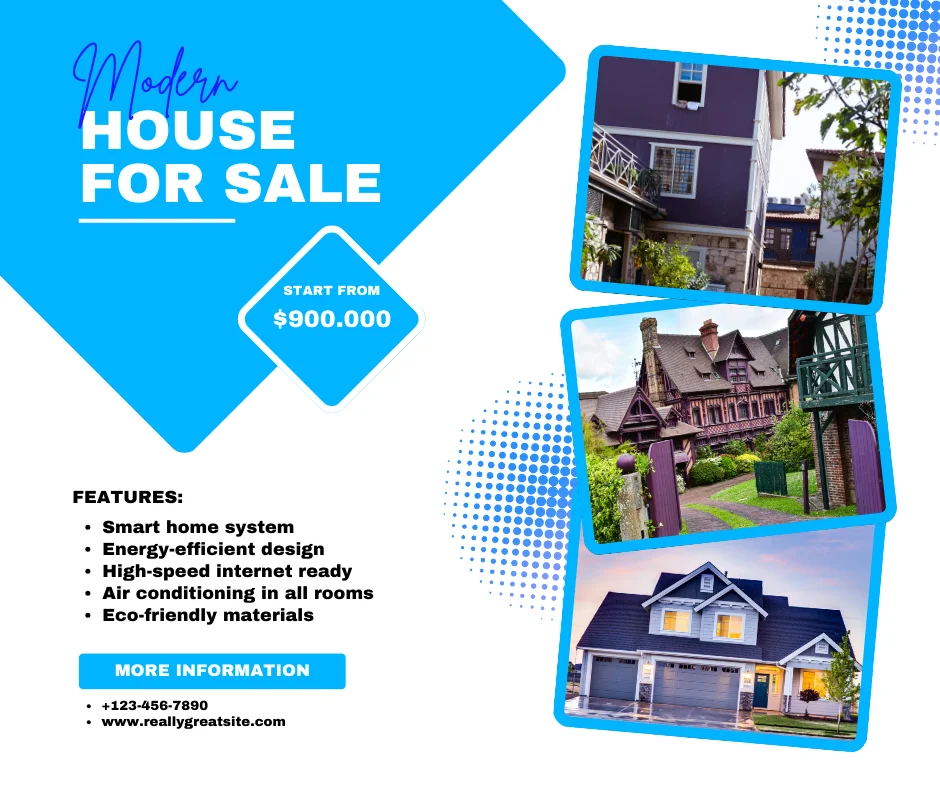
It becomes a decision page.
The Biggest Mistake Agents Make
You lose a lot of good leads when your CTA sits at the very bottom of the page.
Because buyers don’t scroll like they used to. They skim, they click, and they move on fast.
So your CTA needs to show up early. And it needs to show up again in the spots where someone naturally feels ready to take action.
Trend 8: “Proof-Based Marketing” Beats Claims (Reviews, Stats, and Real Signals)
You’ll notice another shift once your listing page starts working like a conversion page.
You can write the cleanest copy in the world, but buyers still won’t trust it if it sounds like marketing.
In 2026, adjectives don’t convince people anymore.
“Spacious.” “Luxury.” “Stunning.” “Prime location.”
Buyers have seen those words on every listing for years.
What they trust now is:
- Numbers
- Proof
- Third-party signals
This is one of the biggest Real Estate Marketing Trends in 2026 because it directly impacts inquiry quality.
What Counts as Proof in Real Estate Marketing
Proof doesn’t need to be complicated. It just needs to be real.
Here are the types of proof that work best:
- The number of properties you’ve sold in that neighborhood or price range
- Your average days on market compared to the area average
- Client review screenshots (from Google, Zillow, Facebook, etc.)
- Verified testimonials that mention a real situation, not generic praise
- Virtual tour views, time spent, or engagement signals
Even small proof blocks can make a buyer feel safer.
And when a buyer feels safer, they ask better questions.
Where to Add Proof on Your Site
This part matters more than most agents think.
Proof works best when it shows up right next to the action.
Here are the placements that work in 2026:
- In a small block near your main CTA
- In the sidebar on listing pages
- Inside your downloadable brochure
- On the virtual tour start screen, before they begin exploring
You’re not trying to brag, but giving buyers a reason to trust you before they give you their time.
Trend 9: Social Media Becomes a Distribution Channel, Not the Main Asset
As soon as you start improving your listing pages and adding proof in the right places, social media starts to feel different.
Because now you’re not posting just to “stay active.”
You’re posting to move people somewhere you actually control.
That matters in 2026 because relying only on Instagram or TikTok is risky. One algorithm change and your reach drops overnight. And even when your content does well, you still don’t own that audience.
So the smartest agents treat social media like a distribution channel that feeds traffic into assets they own:
- Your website
- Your listing pages
- Your virtual tours
- Your email list
The Best “Owned Asset” Funnel for Agents
You don’t need a complicated funnel for this to work. You just need one clean path that you repeat.
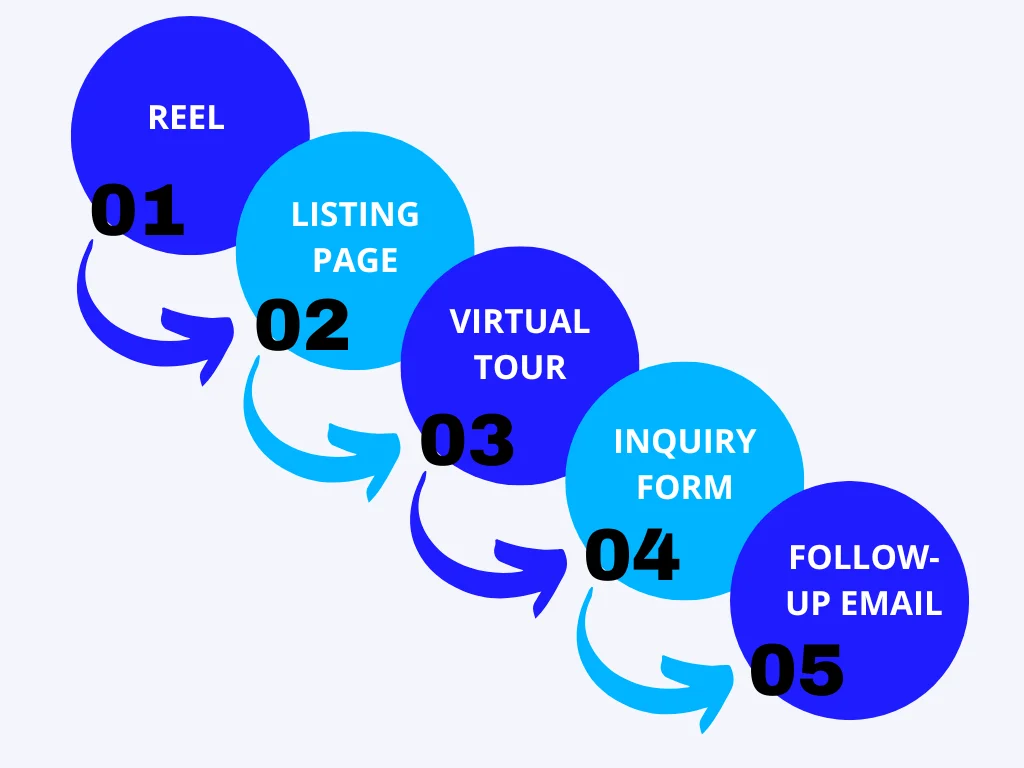
Here’s the simple version that fits how buyers already behave:
Reel → listing page → virtual tour → inquiry form → follow-up email
Das war's.
Now your video doesn’t have to “sell the home.” It only has to earn the click.
And once they land on your site, everything you set up in the earlier real estate marketing trends starts doing the heavy lifting.
Trend 10: Virtual Reality and Interactive Experiences Expand Into Commercial Listings
At this point, virtual tours are already doing a lot for residential listings.
But in 2026, commercial listings start leaning on them even harder.
And it makes sense.
Commercial buyers don’t make decisions the way residential buyers do. The process takes longer, more people get involved, and visits are harder to coordinate. So anything that reduces back-and-forth becomes a serious advantage.
Why Commercial Real Estate Is Catching Up Fast
Commercial virtual tours grow quickly in 2026 because they solve problems that commercial agents deal with every week:
- Decision cycles take longer, so buyers need something they can revisit
- Multiple stakeholders want to see the space before they agree to a visit
- Site visits take more planning, especially for occupied spaces
- Buyers want details upfront, not a sales pitch
- One tour can support multiple uses: leasing, selling, investor updates, and portfolio reviews
Best Use Cases for Commercial Virtual Tours
Virtual tours work especially well for commercial properties where buyers need to understand layout, flow, and scale quickly:
- Retail spaces
- Office walkthroughs
- Warehouses
- Property portfolios
- Learn more about commercial real estate virtual tours- Commercial Real Estate Virtual Tours: A Practical Guide for Brokers [2026]
- Also learn- How to Sell Commercial Real Estate – 10 Proven Steps
How to Choose the Right Real Estate Marketing Trends (So You Don’t Try All 10 at Once)
Now you have the full list.
And if you’re like most independent agents, your first instinct is to try everything at once. That’s also how most people burn out in two weeks and end up changing nothing.
This is the part most trend posts skip. They throw 10 ideas at you and leave you to figure out what matters.
So here’s the simple way to choose, based on the outcome you care about most right now.
If You Want More Qualified Leads
If your biggest problem is getting too many low-quality inquiries, you don’t need more traffic. You need better filtering.
These three real estate marketing trends give you the fastest improvement:
- Trend 1: Immersive virtual tours — so buyers can self-screen before they ever request a visit
- Trend 3: Lead pre-qualification — so your inquiry form stops attracting people who aren’t ready
- Trend 5: Responsiveness — so serious buyers don’t slip away while you’re dealing with tire-kickers
This combo is what reduces wasted visits the fastest.
If You Want More Inquiries From Traffic
If you already have traffic but it isn’t turning into calls, form fills, or tour starts, the issue usually isn’t your marketing.
It’s the gap between the click and the action.
These three real estate marketing trends close that gap:
- Trend 4: Hyperlocal SEO — so the people landing on your site are already searching with real intent
- Trend 7: Listing pages that act like landing pages — so your page actually guides them toward the next step
- Trend 9: Social media as distribution — so your short-form content stops being “views” and starts becoming site visits
This is the setup that turns passive browsing into real inquiries.
If You Want a Better Closing Rate
If your biggest pain is buyers visiting and then disappearing, you don’t need more showings.
You need fewer mismatched showings.
These real estate marketing trends help you tighten expectations before the visit happens:
- Trend 8: Proof-based marketing — so buyers trust what they’re seeing instead of assuming it’s marketing
- Trend 1: Virtual tours — so they understand the property before stepping inside
- Trend 7: Better listing clarity — so important details don’t get missed or misunderstood
When these three are in place, your visits start feeling more like serious decision meetings, not first-time discovery tours.
Wrap Up
At the end of the day, it’s not about chasing every trend on the list. You don’t need all 10 to see results.
What matters is picking 2–3 that address your biggest bottleneck right now, whether that’s getting higher-quality leads, more inquiries, or better closing rates.
The agents who consistently win aren’t the ones trying everything at once. They’re the ones who build repeatable systems, apply the trends consistently, and tweak as they go.
If you’re ready to put one of the most impactful real estate marketing trends into action, start with virtual tours.
Check out our guide on creating a real estate virtual tour to see exactly how to set it up on your listing site without touching any code.
FAQs
1. What are the new trends in real estate?
The biggest Real Estate Marketing Trends in 2026 include virtual tours that pre-qualify leads, short videos that drive clicks, hyperlocal SEO, faster follow-up systems, and proof-based listing pages. Most of these trends support one clear real estate marketing strategy: get buyers to take action faster with less back-and-forth.
2. What are the 4 P’s of real estate marketing?
The 4 P’s are product, price, place, and promotion. In real estate, that maps to the property itself (product), pricing and comps (price), location and lifestyle (place), and your real estate promotion plan across your site, email, and social. This is where strong real estate marketing ideas actually connect to buyer decisions.
3. What is the biggest problem in commercial real estate?
The biggest problem is long decision cycles with multiple stakeholders. A strong real estate marketing strategy fixes this by making the space easier to understand upfront through tours, floor plans, and clear details — so fewer deals stall after the first inquiry. This is where smart real estate market analysis also helps you position the listing correctly.
4. What is the number 1 rule in real estate?
The No. 1 rule is simple: trust wins, and trust comes from speed and clarity. The best marketing ideas for realtors make buyers feel taken care of quickly with clear listing pages, fast follow-up, and proof that reduces hesitation. That’s how you turn interest into showings.
5. What makes a top real estate agent?
A top agent runs systems, not just hustle. They use repeatable real estate marketing ideas, consistent follow-up, strong listing assets, and a clear buyer experience from click to showing. Their real estate promotion works because it filters leads and makes it easy to say yes.